Bridging Content Generation and Scheduled Multi-Platform Syndication
How automated scheduling delivers content to your main website, subsidiary properties, and partner channels without redundant manual effort.

Bridging content generation and scheduled multi-platform syndication requires implementing an event-driven ContentOps architecture that automatically queues approved articles and dispatches them across primary sites, subsidiary properties, and partner feeds via scheduled webhooks and APIs. By decoupling content generation from platform-specific delivery formats and enforcing strict canonical sequencing, organizations maintain an uninterrupted publishing rhythm across multiple web properties without manual distribution friction or duplicate content penalties.
Key Takeaways
- The real bottleneck is rarely drafting speed. Content operations benchmarks show 62% of teams cite approval delays as a top bottleneck, and 74% of content requires multiple reviews across an average chain of 4.2 reviewers.
- Headless CMS architectures decouple content modeling from presentation, delivering structured assets to multiple channels via REST/GraphQL APIs and event-driven webhooks.
- Webhooks push immediately on publish or stage-transition events; RSS-based feeds pull on a scheduled cadence such as hourly or daily.
- Google no longer recommends cross-domain rel=canonical for syndicated content and instead advises the meta robots noindex directive on partner pages.
- Delaying republication by one to two weeks lets search engines index the original on your primary domain first, establishing it as the source of record.
- Reliable multi-endpoint dispatch depends on exponential backoff with full jitter, idempotency headers, and dead-letter queues for exhausted retries.
The Operational Chasm Between Generation Velocity and Multi-Platform Reach
The Trap of Generation Without Orchestration
Accelerating content generation without automating scheduled syndication merely relocates the bottleneck from writers to publishing coordinators. Expensive drafts idle in backlogs, waiting for someone to manually format, place, and publish them across each destination. The data confirms where the friction actually lives: content operations benchmarks show that 62% of teams named approval delays as a top bottleneck, and 74% of content requires multiple approvals across an average chain of 4.2 reviewers. A workflow that only handles draft, review, approve, and publish is a demonstration, not an operating model.

The Friction Cost of Manual Copy-Paste Syndication
When distribution depends on humans remembering to run tasks or on brittle external glue code stitched to a CMS, it breaks precisely where it hurts most: at scale, under deadline, and in front of customers. Manual copy-paste syndication introduces formatting errors, inconsistent metadata, and missed release windows. Every additional destination multiplies the manual labor, so distribution velocity falls further behind generation velocity as the number of properties grows.
Why Fragmented Dispatch Pipelines Erode Topical Cadence
Without a unified pipeline, each property receives content on its own improvised schedule. The result is an inconsistent publishing rhythm that undermines topical authority and makes campaign coordination nearly impossible. ContentOps workflows that rely on ad-hoc manual scripts or unmanaged triggers fail under scale; teams instead need rigid state machines and serverless event-driven execution inside a unified content architecture.
Architecting the Bridge: From Editorial Sign-Off to Scheduled Dispatch
State Machine Transitions: Converting 'Approved' to 'Queued'
The bridge between creation and syndication is a deterministic state machine. When an editor approves a draft, that stage transition becomes an event the system observes rather than a manual handoff someone must remember. Modern headless platforms expose precisely these triggers: webhooks fire on create, update, publish, unpublish, and stage transitions such as review-workflow stage changes and release publishes. Serverless functions can then execute logic in response to those content events, so enrichment, validation, and notification happen inside the same governed system instead of in fragile external scripts.
Decoupling the Content Core from Platform-Specific Presentation Layers
Headless CMS architectures decouple content modeling and storage from presentation layers, delivering structured digital assets to multiple channels and frontends through REST/GraphQL APIs and event-driven webhooks. This separation is the architectural foundation of syndication: you create content once as a structured core, then adapt it for delivery everywhere. API-first architecture lets teams create once and deliver everywhere through standardized endpoints, while webhooks trigger downstream actions when content is published, updated, or deleted.
Centralized Queue Logic: Timezone Balancing and Milestone Coordination
Treating syndication as an immediate simultaneous blast across all web properties is an architectural mistake. Centralized queue logic instead coordinates timing. Modern headless content platforms support release management with atomic multi-asset grouping, stage-transition triggers, and scheduled market-time publishing with automated daylight saving adjustments. A dependable flow models campaign scope, collects dependent documents, attaches them to a release, validates, previews, schedules, publishes, and monitors. Enterprises use this to coordinate multi-brand, multi-region launches with atomic grouping and dependency-aware sequencing.

Technical Delivery Mechanisms for Heterogeneous CMS Ecosystems
Event-Driven CMS Webhooks for Immediate Downstream Ingestion
Webhooks are the connective tissue between an editor hitting publish and a change going live. In a Jamstack architecture, a single HTTP POST to a build provider triggers exactly the right rebuild when content is published. Because webhooks push immediately on relevant events, they are ideal for destinations that need near-real-time ingestion of newly approved content.
Configuring Structured Feeds (RSS, Atom, JSON) for Passive Partner Crawling
Not every downstream destination needs a push. RSS-based syndication operates as a pull mechanism, fetching content on a scheduled cadence such as hourly or daily, whereas event-driven webhooks provide immediate push notifications upon publish or stage-transition events. Structured feeds in XML or JSON are well suited to passive aggregators and partner crawlers that poll your feed origin on their own interval and declare the feed as the canonical source.
Direct API Gateway Orchestration Across Decoupled Stacks
For decoupled stacks and partner ingestion endpoints, a direct API dispatch gateway normalizes article payloads and posts them to each target. This is where careful engineering matters: CMS APIs enforce rate limits and will throttle aggressive bursts, so a staged queue with controlled batch sizes and exponential backoff is more reliable than a direct blast.
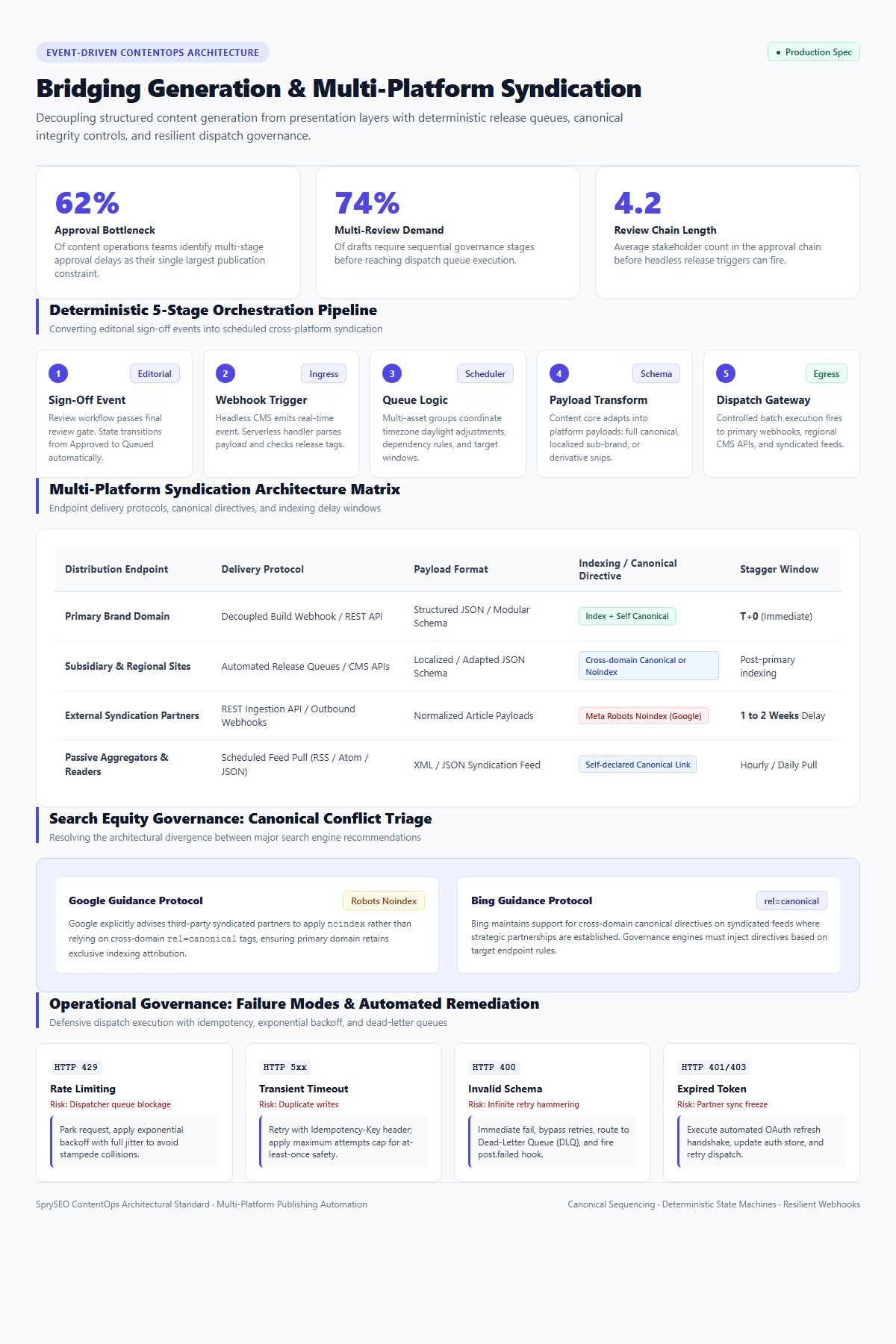
Multi-Platform Syndication Architecture Matrix
| Distribution Endpoint | Delivery Protocol | Payload Format | Indexing / Canonical Directive | Optimal Release Stagger Window |
|---|---|---|---|---|
| Primary Brand Domain | Decoupled Build Webhook / REST API | Structured JSON / Modular Schema | Self-referential Canonical, Index | T+0 (immediate primary source publication) |
| Subsidiary & Regional Sites | Automated Release Queues / CMS APIs | Localized / Adapted JSON Schema | Cross-domain Canonical or Noindex | Staggered release post-primary indexing |
| External Syndication Partners | REST Ingestion API / Outbound Webhooks | Normalized Article Payloads | Meta Robots Noindex (Google recommended) | 1 to 2 weeks delay post-primary index |
| Passive Aggregators & Readers | Scheduled Feed Pull (RSS / Atom / JSON) | XML / JSON Syndication Feed | Self-declared feed origin / Canonical link | Scheduled crawl intervals (hourly / daily) |
Safeguarding Search Equity: SEO and Canonical Governance Across Nodes
Staggered Publishing Sequencing: Prioritizing Primary Domain Indexation
Search engine priority requires deterministic, staggered sequencing that anchors indexing equity to the primary source domain first. Delaying syndication and republication by one to two weeks gives search engines sufficient time to crawl and index the original piece on the primary domain, establishing it as the source of record. Immediate omnichannel distribution risks search engines attributing original indexing equity to a higher-authority partner domain before your own page is indexed.

Cross-Domain Canonical Directives vs. Noindex Directives on Syndicated Hubs
There is a genuine, ongoing tension in syndication SEO. Google updated its technical search guidance to no longer recommend cross-domain rel=canonical tags for syndicated content, instead recommending the meta robots noindex directive on third-party syndicated pages so the primary source retains sole crawling and indexing attribution. Implementing noindex on partner republications is considered the most reliable technique to prevent partners from usurping ranking signals. The conflict worth knowing: Bing still supports cross-domain canonicals where the partnership allows, and many traditional SEO guides historically mandated canonicals instead of noindex. Your governance layer should therefore set the correct directive per endpoint rather than applying one rule universally.
Mitigating Passage Cannibalization Across Subsidiary Properties
When syndication is handled poorly, it can trigger duplicate content concerns. The combination of staggered release timing and the correct indexing directive per node is what keeps subsidiary and partner properties from competing with the primary domain for the same queries. The architecture matrix above encodes this: self-referential canonical and index on the primary domain at T+0, and noindex or controlled canonical directives on downstream hubs released later.
Formatting Adaptation Across Multi-Tier Publishing Targets
Standardizing Metadata Envelopes for Main Domains, Sub-Brands, and Feeds
Content syndication is the strategic distribution of digital assets across multiple platforms, and each platform expects its own schema. Because a headless CMS stores content independently from presentation, the same structured core can be transformed into platform-specific payloads: a full self-canonical article for the primary domain, a localized JSON schema for a regional sub-brand, and a normalized feed entry for a partner. Standardizing the metadata envelope at the core means downstream adaptation is a transformation step, not a manual rewrite.
Automating Derivative Summaries and Modular Snips for Partner Feeds
Modular content components make it possible to generate derivative formats, such as summaries or excerpts, for partner feeds while keeping the full article on the primary domain. Supplying excerpts rather than full text to some partners is one lever in the broader canonical strategy, and automating that transformation inside the pipeline removes the manual formatting errors that plague copy-paste syndication.
Operational Governance: Cadence Reliability, Retries, and Error Triage
Idempotency and Automated Retry Handshakes for Dropped Dispatches
Reliable dispatch across third-party endpoints and CMS APIs depends on three mechanisms working together: exponential backoff with full jitter, idempotency request headers to prevent duplicate operations, and dead-letter queues after retry exhaustion. Retries guarantee at-least-once delivery, meaning duplicate deliveries are expected, so idempotency keys ensure that processing the same event multiple times produces the same result. Full jitter is recommended to reduce retry collisions and to prevent failures caused by the recurring load of the webhook attempts themselves.
Classifying Failures Instead of Blindly Retrying
Provider dispatch errors must be classified rather than blindly retried. Rate-limited responses should trigger a wait state, transient server errors should initiate exponential backoff retries, and client-side bad requests should fail immediately, because retrying a rejected payload only repeats the rejection. Exhausted retries land in a dead-letter queue and fire a failure hook so a person or integration finds out.
Syndication Dispatch Failure Modes & Automated Recovery Protocols
| Failure Scenario | Delivery Mechanism | Systemic Risk | Automated ContentOps Remediation |
|---|---|---|---|
| Endpoint Rate Limiting (429) | REST API / Webhook | Dispatcher throttled; queue blockage | Park request, apply exponential backoff with full jitter |
| Transient Network Timeout (5xx) | HTTP Webhook POST | Duplicate posting or partial writes | Retry with Idempotency-Key header; maximum attempts cap |
| Invalid Payload Schema (400) | API Dispatch Gateway | Infinite retry hammering; silent failures | Immediate fail, route to Dead-Letter Queue (DLQ), trigger post.failed hook |
| Expired Authentication Token | Partner Ingestion API | Failed multi-platform sync | Automated token refresh handshake, then retry dispatch |
ContentOps Metrics: Cadence Adherence, Dispatch Latency, and Endpoint Health
Governance closes the loop. Tracking cadence adherence, dispatch latency, and endpoint health turns syndication from an opaque blast into a measurable operating system. These metrics reveal when a downstream endpoint is degrading, when the queue is backing up, and whether the publishing rhythm you designed is actually holding across every property. Combined with staged queues and classified retries, this monitoring is what keeps a multi-platform pipeline consistent as volume rises.

Author Box
This article was prepared by the SprySEO editorial team. SprySEO is an SEO and GEO content automation platform that connects website analysis, topic planning, AI article generation, SEO and GEO checks, and scheduled publishing. The team writes for content operations managers, SEO specialists, and marketing teams who need to scale organic search rankings and AI answer engine citations across multiple sites and languages.
Disclaimer
This content is provided for informational purposes only and reflects search engine guidance and technical practices available at the time of writing. Search engine indexing behavior, CMS capabilities, and syndication recommendations change over time and can differ between providers. Validate canonical directives, delivery protocols, and release timing against your own platforms and the current official documentation before implementation. Nothing here is a guarantee of specific search rankings or business outcomes.
Frequently asked questions