Coordinating Content Dispatch Across Distributed Marketing Teams
Synchronize regional campaign schedules and localized releases using shared publishing calendars that prevent conflicting launches and maintain steady content output.

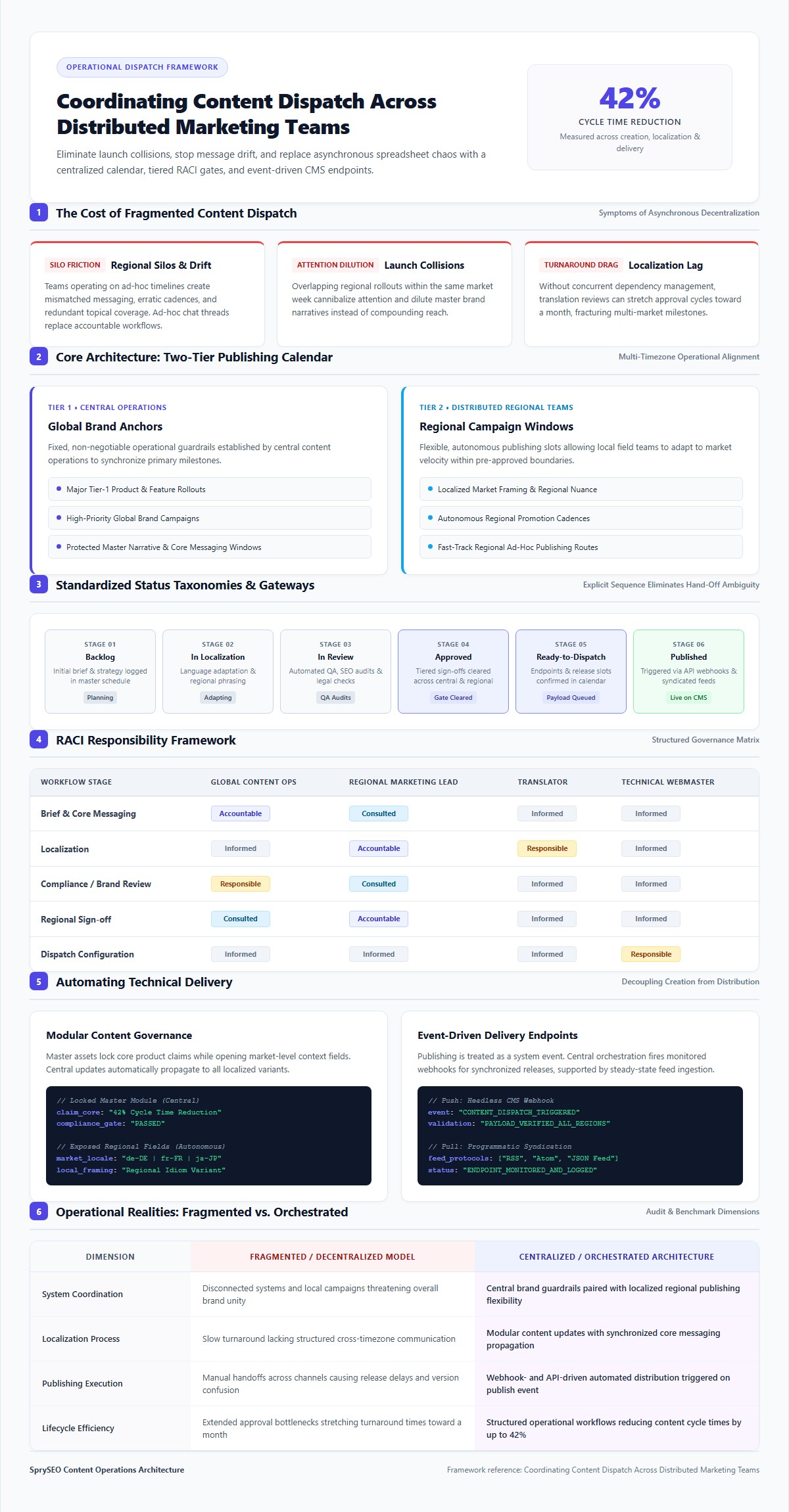
Coordinating content dispatch across distributed marketing teams requires replacing fragmented local spreadsheets with a centralized publishing engine governed by clear tier-based approval gates and automated delivery. By decoupling central asset approval from scheduled regional CMS endpoints, organizations eliminate launch collisions, prevent duplicate topical coverage, and ensure multi-region campaigns execute on predictable, synchronized schedules.
The operational reality is harsher than most org charts suggest. When regional teams publish on independent timelines, campaigns cannibalize each other, localized versions drift from master messaging, and the same topic gets covered repeatedly across different markets. Bridging this gap requires connecting organizational governance directly to technical delivery mechanics.
Key Takeaways
- Decentralized teams operating independently often create separate systems, strategies, and campaigns, which threatens overall brand consistency.
- A centralized global publishing calendar aligns multi-channel campaigns across time zones while balancing central guardrails with regional flexibility.
- A modular content strategy lets core messaging be defined once and adapted across markets, so updates to a single module propagate across local instances.
- Headless CMS publish webhooks turn publishing into a system event that triggers automated validation and distribution, but endpoint proliferation without orchestration risks silent failures.
- Structured content operations workflows have reduced content lifecycle cycle times by up to 42%, measured through content velocity, cycle time, and error rates.
The Operational Bottleneck of Fragmented Content Dispatch
Fragmentation is the default state of any distributed marketing organization that scales faster than its underlying processes. Without clear operational guardrails, the symptoms surface quickly and compound over time.
Regional Silos and the Hidden Cost of Asynchronous Publishing
When decentralized teams operate independently, organizations end up juggling disparate systems, strategies, and campaigns that undermine brand consistency. Every regional silo operating on its own publishing cadence introduces another point of divergence from the global brand. Rather than showing up cleanly on a single dashboard, this friction accumulates as mismatched messaging, erratic timing, and redundant topical coverage.
Coordination breaks down whenever ownership is ambiguous, feedback loops stall, or handoffs lean on ad-hoc chat channels rather than structured workflows. A Slack message is not a commitment, and a chat thread is not a workflow. Whenever cross-timezone handoffs live only in ephemeral chat logs, operational continuity inevitably collapses.

Launch Collisions: When Uncoordinated Campaigns Cannibalize Attention
When two regions launch overlapping initiatives in the same week, they do not double their reach—they fracture audience attention and dilute the master narrative. Without a single, shared view of what is deploying where and when, collisions are inevitable. Lacking a single source of truth, teams cannot easily spot when a global product rollout and an aggressive regional promotion are competing directly for the same audience.
Localization Lag: Why Regional Teams Fall Behind Global Milestones
Localization remains a persistent bottleneck in distributed marketing. Without an organized communication strategy, regional adaptation often stalls. Translation turnaround becomes the unaddressed dependency that pulls synchronized launches off schedule. If a global launch milestone assumes concurrent multi-market delivery while three languages are still mired in review, the rollout either slips entirely or fractures into disconnected parts. Prolonged approval chains compound the drag: across some teams, the average approval cycle for an individual asset stretches toward a month, leaving writers idle and version control compromised.
Core Architecture of a Centralized Global Publishing Calendar
A shared, authoritative publishing calendar serves as the primary operational fix for fragmentation, equipping multi-channel teams to coordinate planning and campaign alignment across varied time zones.
Defining Global Brand Anchors vs. Regional Campaign Windows
A reliable calendar operates across two distinct layers: fixed global brand anchors (major product rollouts, high-priority brand campaigns, non-negotiable messaging windows) and flexible regional campaign windows where local teams execute autonomously. Central operations establishes the operational guardrails, leaving regional teams free to maneuver within those parameters. This structure preserves global rollout coherence while allowing regional marketers to match local market velocity.
Establishing Multi-Timezone Visibility and Milestone Transparency
International teams coordinate launches across time zones and manage content in dozens of languages. A calendar that fails to render these time zones transparently invites scheduling conflicts. Every milestone, dependency, and release slot must be visible to all stakeholders regardless of location. Complete operational visibility is not a luxury—it is the direct mechanism that halts asynchronous drift.

Status Taxonomies: From Backlog and Localization to Ready-to-Dispatch
Without a standardized status vocabulary, a calendar devolves into a wall of ambiguous entries. Teams need explicit, standardized stages: backlog, in localization, in review, approved, ready-to-dispatch, and published. Every status should tie directly to a defined owner and an explicit next action. This shared taxonomy bridges planning and execution, confirming that when an asset reaches ready-to-dispatch, all upstream gates have formally cleared.
Structuring Approval Gates and Localized Governance
Structured workflows outperform ad-hoc coordination by making accountability and operational sequence explicit. This clarity is where RACI modeling provides real structural value.
Tiered Editorial Workflows: Central Compliance vs. Regional Nuance
Tiered review models explicitly separate central compliance verification (brand guidelines, legal checks, core claims) from regional nuance adjustments (tone, regional idioms, market-specific framing). Conflating these into a single, generic approval step stalls production. Implementing a structured RACI framework defining who is Responsible, Accountable, Consulted, and Informed across briefs, drafts, edits, sign-offs, and final deployment eliminates operational ambiguity.
The following RACI matrix illustrates how key responsibilities distribute across a multi-region dispatch pipeline:
| Stage | Global Content Ops | Regional Marketing Lead | Translator | Technical Webmaster |
|---|---|---|---|---|
| Brief & core messaging | Accountable | Consulted | Informed | Informed |
| Localization | Informed | Accountable | Responsible | Informed |
| Compliance / brand review | Responsible | Consulted | Informed | Informed |
| Regional sign-off | Consulted | Accountable | Informed | Informed |
| Dispatch configuration | Informed | Informed | Informed | Responsible |
Modular Content Governance: Locking Core Claims While Adapting Local Context
Modular content frameworks allow organizations to define core positioning once and adapt it across territories without brand drift, propagating central updates to all localized variants automatically. This architecture reconciles the tension between brand consistency and regional autonomy directly at the content layer: lock non-negotiable claims into standardized master modules, while exposing local-context fields for market-level adaptation. Shifting away from monolithic production pipelines toward modular, automated content supply chains unlocks genuine operational agility.

Automated QA Gateways: SEO Checks, Translation Audits, and Legal Reviews
Approval gates should not rely purely on manual oversight. Automated QA gateways can validate SEO parameters, surface missing localization strings, and route necessary compliance reviews before content reaches staging environments. These programmatic gates mirror the discipline of the status taxonomy: an asset cannot progress until automated checks pass, standardizing baseline quality across regions that might otherwise apply divergent editorial standards.
Technical Dispatch: Automating Delivery Across Disparate CMS Endpoints
A global calendar and governance model outline operational intent; dispatch automation ensures technical execution reliability.
Decoupling Content Generation from Regional Distribution Channels
Modern content architectures decouple creation from downstream distribution. By leveraging headless CMS infrastructure, content teams can draft, edit, and review assets within a single workspace while programmatically delivering unified experiences across disparate endpoints via APIs. Content reuse drives efficiency: master assets are approved once centrally and syndicated outward to regional endpoints without manual re-entry.
Automating Scheduled Dispatch via Webhooks and API Triggers
Headless CMS architectures treat content deployment as an explicit system event: an automated publish webhook triggers a service that validates the payload, updates target records, and orchestrates multi-channel release. Treating publication as an event replaces fragile, manual copy-pasting across disparate CMS instances. Once a team moves to event-driven architectures, manual cross-posting across channels becomes an obsolete practice.

However, technical teams must manage the risks of endpoint sprawl. Setting up simple per-collection webhooks without end-to-end orchestration across multiple locales, brands, and publishing stages frequently leads to silent dispatch failures. The objective is not to pull back on automation, but to establish centralized orchestration so that triggered events are actively monitored, validated, and logged rather than fired blindly.
Managing Feeds and Syndication: RSS, Atom, and Structured JSON Workflows
Alongside real-time webhooks, syndication pipelines built on RSS, Atom, and structured JSON feeds enable downstream properties to ingest approved assets programmatically. Feed ingestion is ideal for receiving platforms designed to poll for updates on local schedules rather than receiving inbound pushes. Combining outbound webhooks for synchronized, time-critical launches with pull-based feeds for steady-state syndication provides regional endpoints with dependable ingestion pipelines.
Centralized Governance vs. Regional Autonomy: Resolving Operational Friction
The central operational challenge in distributed marketing operations is establishing the boundary between central brand control and regional execution speed.
The Mandate vs. Flexibility Tradeoff in Fast-Moving Markets
Rigid central governance safeguards brand equity but can stifle regional market responsiveness. Resolving this tension requires intentional operational boundaries: platforms built for multi-location teams allow central leadership to set baseline guardrails while granting regional operators the leeway to publish within them. Modular content governance operationalizes this balance by locking non-negotiable brand elements while leaving localized execution fields open to market demands.
Handling Urgent Regional Ad-Hoc Releases Without Derailing the Master Calendar
Unplanned regional releases will always occur. Master calendars must accommodate these needs through dedicated fast-track routing with compressed approval gates, rather than forcing local teams to bypass governance entirely. Routing urgent regional initiatives through an expedited compliance check while logging them in the central schedule maintains visibility, ensuring one market's urgent deployment does not spark collisions across adjacent territories.
Measuring Dispatch Efficiency and Cadence Health
Coordinated workflows depend on measurable operational data. Concrete metrics transform an abstract publishing schedule into an auditable, trackable operational engine.
Essential Operational KPIs: Cycle Time, Cadence Adherence, and Conflict Frequency
Key performance indicators for evaluating content operations include content velocity (the speed of asset creation and delivery), cycle times, workflow completion rates, operational error counts, and overall launch speed. Tracking these variables across regions uncovers production bottlenecks and proves whether teams are adhering to the global calendar. Enterprise content operations platforms have demonstrated cycle-time reductions of up to 42% across briefing, creation, approval, localization, and distribution, establishing a clear efficiency benchmark for structured workflows.
The matrix below contrasts the operational realities of fragmented versus orchestrated delivery:
| Operational Dimension | Decentralized / Fragmented Approach | Centralized / Orchestrated Architecture |
|---|---|---|
| System coordination | Multiple disconnected systems and campaigns threatening brand unity | Central guardrails paired with localized publishing flexibility |
| Localization process | Slow turnaround lacking structured communication | Modular content updates with aligned core messaging |
| Publishing execution | Manual handoffs across channels causing delays and version confusion | Webhook- and API-driven automated distribution triggered on publish |
| Lifecycle efficiency | Approval bottlenecks stretching turnaround times | Structured workflows reducing cycle times by up to 42% |
Continuous Workflow Auditing: Post-Mortems on Release Bottlenecks
Operational metrics are only valuable when incorporated into a continuous feedback loop. Conducting regular post-mortems on pipeline bottlenecks, approval stalls, and technical delivery failures closes visibility gaps. Because cross-timezone handoffs represent the most common point of coordination failure, systematically auditing these transitions and reinforcing them with structured operational workflows provides the most durable long-term efficiency gains.
Author
This article was prepared by the SprySEO editorial team. SprySEO is an SEO and GEO content automation platform that connects website analysis, topic planning, AI article generation, SEO and GEO checks, and scheduled publishing, including dispatch to CMS platforms via webhooks and RSS, Atom, and JSON feeds, to help brands maintain consistent publishing rhythms across multiple sites and languages.
Disclaimer
This content is provided for general informational purposes only and does not constitute operational, legal, or technical advice. Specific metrics, platform capabilities, and governance outcomes vary by organization and implementation. Evaluate tools, workflows, and benchmarks against your own context and requirements before adopting them.
Frequently asked questions