Diagnosing Underperforming Content in the Era of AI Answers
How content operations teams can audit declining search visibility and rewrite underperforming pieces to satisfy current generative engine retrieval standards.

Diagnosing underperforming content in the era of AI answers requires distinguishing traditional rank loss from generative retrieval exclusion. Traffic drops no longer automatically point to slipping positions. Pages frequently maintain their search rankings while losing clicks because AI-generated summaries answer queries directly on the results page. Addressing this displacement demands a structured audit across four core vectors—Information Gain deficits, passage extraction friction, factual grounding degradation, and search intent drift—followed by clear triage decisions to prune, consolidate, or rebuild affected assets into modular, fact-dense, extractable resources.
Key Takeaways
- AI search reduces clicks rather than organic rankings alone, driving documented traffic declines between 30% and 70%.
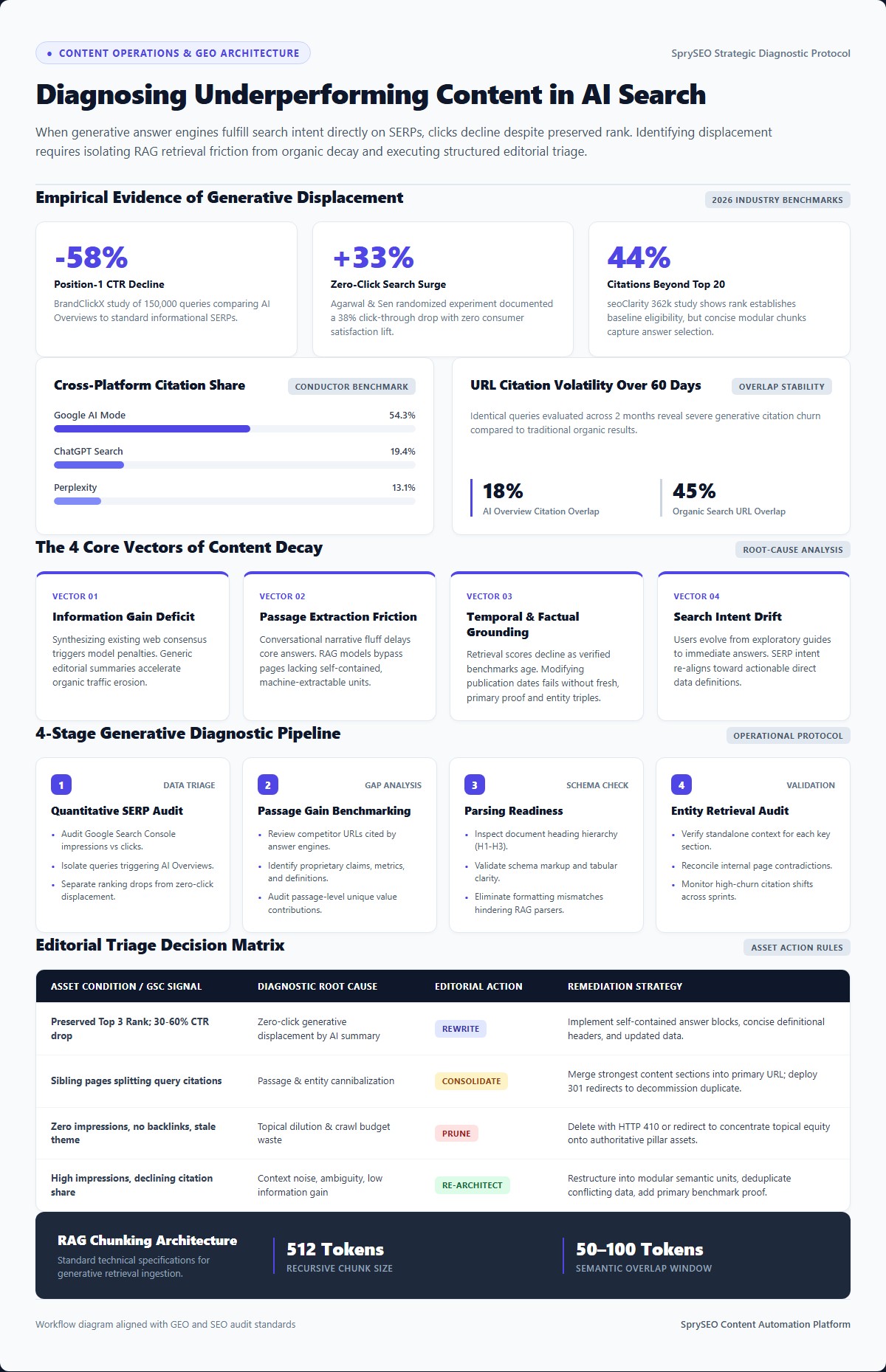
- Google AI Overviews correlate with up to a 58% drop in top-position CTR; a randomized field experiment recorded a 38% decline in organic click-throughs alongside a 33% increase in zero-click searches.
- Answer engines frequently bypass relevant URLs due to context noise, ambiguity, conflicting information, and formatting mismatches rather than a missing answer.
- Generative citations remain volatile: identical queries run two months apart shared only 18% of cited URLs in AI Overviews, compared to a 45% overlap in organic search.
- Content teams need explicit editorial criteria to determine whether an underperforming asset should be rewritten, merged via 301 redirect, or pruned entirely.
The New Taxonomy of Content Underperformance in Generative Search
Traditional Ranking Decay vs. Zero-Click Generative Displacement
Historically, falling organic traffic pointed to familiar culprits: algorithm adjustments, aggressive competitors, or decaying query relevance. Today, that diagnostic model is incomplete. AI Overviews satisfy search intent directly on the SERP, suppressing organic clicks even when your rankings hold steady. When users find what they need in the overview, the outbound click never occurs—creating traffic losses that standard rank tracking cannot explain.
The data confirms this shift. The presence of Google AI Overviews is associated with a 58% reduction in CTR for position-one organic results. In a preregistered randomized field experiment, AI Overviews drove a 38% decrease in organic click-throughs and a 33% surge in zero-click searches, without producing any measurable rise in user-reported satisfaction. Across observed searches, AI Overviews surfaced in roughly 41% of queries, curbing outbound organic clicks by approximately 40%. For content teams, the baseline diagnostic rule is clear: rule out zero-click displacement before treating a traffic drop as a content quality or ranking issue.
The Anatomy of Retrieval Failure: Why Models Bypass Valid URLs
Beyond front-end displacement lies a technical hurdle: retrieval exclusion. Within Retrieval-Augmented Generation (RAG) pipelines, extraction failures occur when an answer exists in the source text but the model fails to pull it out due to context noise, ambiguity, contradictory statements, or poor formatting. A page can be fully indexed, competitively ranked, and accurate, yet still get skipped if its key points are buried in conversational fluff or clash with other retrieved context.
Strong organic rankings increase citation odds, but they do not guarantee them. An analysis of 362,000 keywords revealed that 94% of AI Overviews cite content ranking in the top 20—with position one cited 43% of the time, dropping to 7% by position 20. Significantly, 44% of citations came from URLs outside the top 20. While rank establishes baseline eligibility, clear formatting and high information density determine whether an engine actually extracts and cites your text.

Metrics That Matter: Moving Past Raw Organic Sessions to Retrieval Inclusion
Standard ranking reports no longer reflect where visibility is gained or lost. Operational reporting must expand to track generative visibility metrics: citation share, prompt coverage, and answer inclusion. Citation distributions also diverge substantially across platforms. In a publishing benchmark, Google AI Mode generated 54.3% of analyzed citations, outpacing ChatGPT (19.4%) and Perplexity (13.1%) combined.
Empirical Impact of Generative Answer Engines on Search CTR and Traffic
| Study / Metric Source | Observed Generative Feature | Traffic / CTR Impact | Key Finding Details |
|---|---|---|---|
| Agarwal and Sen Field Experiment (2026) | Google AI Overviews | 38% CTR reduction; 33% increase in zero-click searches | Randomized field experiment; no compensating gain in user satisfaction. |
| BrandClickX / GSC Aggregated Study (2026) | Google AI Overviews | 58% lower position-one CTR | Comparison of 150,000 AIO queries vs. 150,000 standard informational queries. |
| Ziptie.dev Research | Desktop AI Overviews (13%+ frequency) | 17% to 61% organic CTR decline; up to 58% position-one compression | Ranking retention does not protect against zero-click traffic loss. |
| Conductor Publishing Benchmark (2026) | Cross-platform citation distribution | AI Mode 54.3%, ChatGPT 19.4%, Perplexity 13.1% | Google AI Mode dominates generative citations in publishing. |
| seoClarity 362k Keyword Study | AIO organic ranking correlation | Position 1 cited 43%; Position 20 cited 7%; 44% from outside Top 20 | Rank drives inclusion probability, but over 40% comes from unranked pages. |
Root-Cause Diagnostics: Why Established Content Stops Performing
Information Gain Deficits: The Penalty of Generic Consensus Summaries
Articles that merely synthesize existing web consensus offer nothing an answer engine cannot generate internally. When a page maintains high impressions but loses citations and model selection, it usually suffers from low Information Gain, semantic ambiguity, and noise. Around 68% of websites experience annual traffic loss linked to content decay, and generic editorial coverage sharply accelerates that loss in retrieval-first environments.
Passage Extraction Bottlenecks: Prose Fluff vs. Self-Contained Direct Answers
Generative engines reward passages that function as self-contained answers, favoring modular layouts, descriptive subheadings, and fresh data. Long narrative transitions that postpone the core answer introduce friction during extraction. To fix this, structure content with direct answer blocks, clear definitional headings, and unambiguous facts that models can parse without sorting through conflicting text.
Factual Grounding and Temporal Decay: Stale Benchmarks and Missing Primary Proof
Content Freshness Decay reflects a measurable drop in a page's retrieval score as its verified information ages. Updating decaying content requires far more than changing the publication timestamp and rewriting introductory sentences. Modern retrieval systems evaluate semantic density and penalize outdated data rather than rewarding superficial CMS metadata edits. Upgrading pre-AI content with explicit subheads, concrete answers, and verified data resolves temporal degradation while fixing structural extraction problems.
Search Intent Drift: How User Expectations Shift from Exploratory to Direct Solutions
As searchers adapt to instant generative summaries, queries that once favored comprehensive, open-ended guides now demand concise solutions. When impressions hold steady while click volume drops, the target query's underlying intent may have shifted. Evaluating current SERP features and AI Overview outputs reveals the exact answer formats engines prioritize, providing a blueprint for content realignments.
A Structured 4-Stage Diagnostic Audit Framework
Stage 1: Quantitative Data Triage
Start in Google Search Console. If impressions stay steady while clicks decline, prioritize zero-click displacement over ranking loss. Segment queries by the presence of AI Overviews, identifying URLs where CTR dropped without a matching decline in average position. This step isolates algorithmic displacement from organic ranking decay before editorial work begins.
Stage 2: Semantic Gap Analysis Against Current Cited Competitors
Review the URLs that answer engines cite for your target queries to identify what unique context, facts, or angles they offer. This requires a passage-level evaluation of Information Gain rather than a traditional keyword gap analysis. Pinpoint the specific claims, primary figures, and structural definitions securing citation visibility for competitors.
Stage 3: Technical Parsing and Schema Readiness Verification
Confirm that your content is indexable and that its document structure parses cleanly. Because formatting mismatches trigger extraction failures in RAG pipelines, ensure that headings, ordered lists, and schema markup present key answers in clear, machine-readable formats rather than buried within uninterrupted text blocks.
Stage 4: Passage-Level Retrieval and Entity Association Checks
Assess whether individual sections can function independently as complete answers, with core entities clearly defined alongside their primary attributes. Remove internal contradictions across the page, as conflicting data points undermine extraction confidence. Given that generative citations shift rapidly—identical queries repeated two months apart showed only 18% page overlap in AI Overviews versus 45% in organic results—passage checks must be part of an ongoing operational routine.

The Editorial Triage Decision Matrix: Rewrite, Consolidate, or Prune?
When to Rewrite: Preserving Existing Authority with Structural Upgrades
Pages that preserve top-three organic rankings yet suffer a 30% to 60% CTR drop are prime candidates for structural rewrites. The domain authority is already there; the layout simply fails modern extraction criteria. Upgrading these assets requires structural re-engineering—introducing standalone answer passages, crisp heading structures, and fresh data points—rather than minor copy tweaks.
When to Merge: Resolving Passage Cannibalization Across Sibling Pages
If two related pages compete for identical queries and divide citation signals, combine them. The standard remediation involves merging the strongest sections into a primary URL, implementing 301 redirects, and updating canonical tags or intent focus. Leaving cannibalizing pages active out of concern for residual traffic fractures passage scores and dilutes overall topical authority.
When to Prune: Eliminating Dead Weight to Protect Crawl and RAG Budgets
Pruning is the right path for thin, dated pages that drive negligible traffic and hold zero backlink equity. Deleting or redirecting these assets concentrates topical equity onto authoritative assets and improves crawl efficiency. Retaining stagnant URLs dilutes topical authority across generative engines, making systematic pruning an essential maintenance practice.

Editorial Triage Decision Matrix for Decaying and AI-Displaced Content
| Asset Scenario / Metric Condition | Diagnostic Root Cause | Recommended Editorial Action | Technical & Structural Remediation |
|---|---|---|---|
| Maintains Top 3 rank but experiences 30-60% CTR drop | Generative zero-click displacement by AI summary | Structural rewrite for passage extraction | Implement self-contained answer blocks, concise definitional headers, and updated data. |
| Two sibling pages competing for overlapping queries / split citations | Passage and keyword cannibalization | Consolidate & merge | Merge strongest sections into primary URL, set 301 redirects, decommission duplicate. |
| Zero meaningful impressions, zero backlinks, irreversibly outdated topic | Topical dilution, dead crawl budget weight | Prune (delete / 410 or redirect) | Remove thin pages to concentrate topical authority and conserve retrieval scoring. |
| High impression share but declining citations and low model selection | Context noise, semantic ambiguity, lack of information gain | Information gain audit & chunk re-architecture | Format into semantic units, remove prose fluff, deduplicate contradicting facts. |
Systematic Content Rehabilitation: Engineering the GEO Refresh
Restructuring for RAG Chunking: Heading Hierarchies and Definitive Leads
Effective content remediation starts with breaking text into modular, retrievable components. RAG testing supports recursive character splitting at 512 tokens with a 50-to-100 token overlap as a standard baseline. Practically, this means structuring sections as independent semantic units: anchor each block with an explicit heading and open with a definitive lead sentence answering the core query before expanding into detail.
Injecting Information Gain: Proprietary Data, Case Benchmarks, and Clear Triples
Securing citations requires publishing details that answer engines cannot pull from general web consensus. Add proprietary findings, verified industry benchmarks, and clear entity-attribute-value triples. Simultaneously, reconcile any conflicting statements across your assets, as contradictory facts represent a primary driver of extraction failure.
Optimizing Tabular Density: Transforming Unstructured Narrative into Scannable Tables
Structured tables turn dense text into easily extractable reference data. Because AI systems favor passages that provide self-contained answers, clean comparison tables regularly become the primary snippets selected by retrieval models. Managing this technical structure alongside engaging prose is straightforward: lead with the machine-extractable answer first, then provide broader analytical context throughout the supporting paragraphs.

Operationalizing Continuous Content Audits in Publishing Pipelines
Automating Decay Alerts Based on Trajectory Thresholds
Content decay happens incrementally, making automated detection essential. Tracking impression-to-click ratios and content age thresholds surfaces slipping URLs before their organic visibility erodes completely, routing them directly into your editorial workflow. Catching displacement and retrieval drift early allows teams to protect and reinforce existing page authority.
Establishing Post-Refresh Re-Evaluation Windows and SLAs
Generative citations fluctuate regularly, as seen in documented instances of single-week citation drops across major engines. A one-time post-refresh check will not capture long-term performance. Set recurring review intervals to track re-indexing, passage extraction recovery, and citation trends over time. Sustained Generative Engine Optimization relies on continuous measurement rather than isolated fixes.
About the Author
This article was produced by the SprySEO editorial team. SprySEO is an SEO and GEO content automation platform that connects website analysis, topic planning, AI article generation, SEO and GEO checks, and scheduled publishing, helping brands gain visibility in both search engines and AI answers. Our team works with content operations managers, SEO specialists, and digital marketing teams to scale organic search rankings and AI answer engine citations across multi-site and multilingual workflows.
Disclaimer
This article is provided for informational purposes only and reflects research and industry data available at the time of writing. Generative search behavior, citation patterns, and algorithmic ranking factors change frequently and vary across platforms. The statistics and findings cited here describe observed studies and benchmarks and are not guarantees of outcomes for any specific website. Teams should validate diagnostic and remediation decisions against their own analytics data before acting.
Frequently asked questions