Transforming Brand Knowledge Bases into Scalable Content Engines
Harness internal product guides, support documentation, and case studies to power authoritative, automated article production that answers real customer queries.

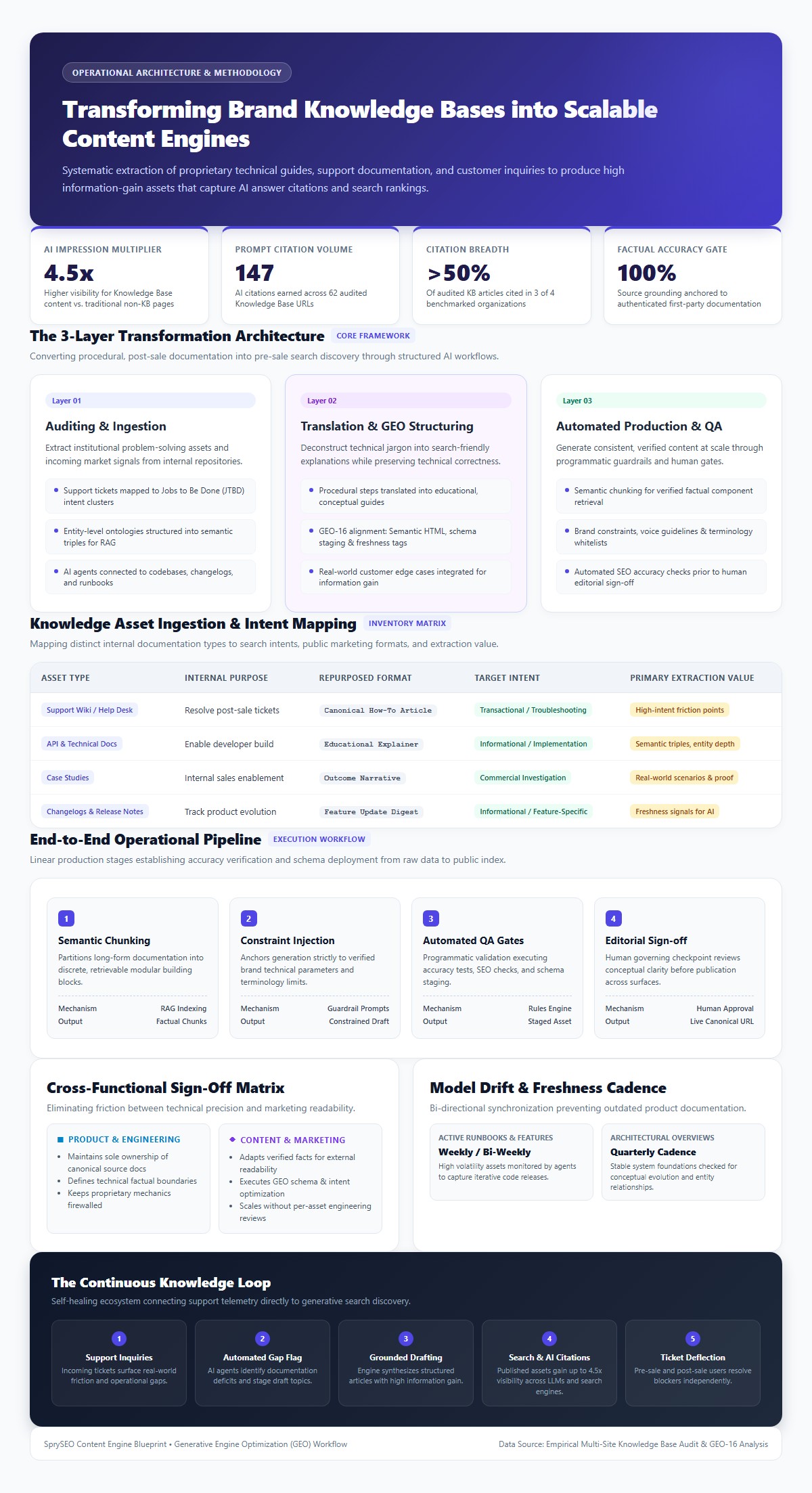
Transforming brand knowledge bases into scalable content engines means systematically extracting proprietary technical guides, support documentation, and customer inquiries, then feeding them through structured AI generation workflows with strict brand constraints. By translating post-sale problem-solving assets into pre-sale, search-optimized educational resources, brands produce authoritative articles with high information gain that capture search rankings and generative AI citations without hallucinating.
Most organizations sit on an extensive repository of vetted workflows, troubleshooting steps, and institutional judgment—the exact material modern search engines and LLMs prioritize. Yet these assets typically stay locked behind authentication walls or buried inside help desk software, invisible to discovery systems. Unlocking that repository requires an operational pipeline designed specifically for extraction, transformation, and automated quality control.
Key Takeaways
- Knowledge Base content can earn up to 4.5x more generative AI impressions than traditional non-KB web pages, driven by higher information gain and structured context.
- Google rewards content with measurable information gain, favoring unique utility over regurgitated web consensus — a bar proprietary documentation naturally clears.
- A durable content engine requires three layers: auditing and ingestion, a translation layer that converts procedural docs into reader-friendly articles, and an automated production pipeline with brand guardrails.
- Model drift — the divergence between what your product does and what AI thinks it does — is managed through freshness metadata, governed review cadences, and bi-directional synchronization.
- Resolving friction between marketing and engineering teams requires governance boundaries where marketing draws on technical facts without diluting the source documentation.
The Untapped Goldmine: Why Documentation Outperforms Generic Content
The Information Gain Advantage of Proprietary Product Knowledge
Google evaluates relevance, pertinence, and quality through mechanisms such as information gain scores, prioritizing content that delivers unique utility and depth over material summarizing web consensus. Information gain SEO has emerged around this principle, focusing specifically on earning AI citations through measurable content differentiation.
Internal documentation provides an immediate structural edge here. An organization's proprietary knowledge base—spanning proven workflows, institutional processes, document standards, tacit expert judgment, and internal data—serves as a defensible moat. Competitors cannot replicate it, and generic models cannot synthesize its specificity. Publishing derived articles from these assets surfaces information absent from the rest of the open web.
From Post-Sale Support to Pre-Sale Search Discovery
Confining technical documentation to post-sale customer support underutilizes valuable brand authority. A troubleshooting guide that resolves an open support ticket can just as easily address a prospect's technical evaluation query during pre-sale research. When structured effectively, a help-center article becomes a canonical problem-solving asset that captures organic demand precisely when buyers encounter operational friction.
Empirical research reinforces this dynamic. Across an audit of four websites, 62 individual Knowledge Base URLs generated 147 citations across monitored AI prompts; at three of the four organizations, over half of the audited articles earned at least one citation. In comparative evaluations, Knowledge Base content generated up to 4.5x more generative AI impressions than traditional, non-KB pages.

Bypassing the AI Monoculture with Verified Brand Context
Scaling AI-generated content without grounding it in first-party documentation produces commoditized, low-value material that generative search engines actively deprioritize. Converting approved documentation, help centers, and internal resources into structured retrieval repositories anchors AI outputs to authenticated company knowledge, establishing verified context that prompt-only workflows cannot replicate.
Auditing and Ingesting Brand Knowledge Assets
Categorizing Internal Assets: Support Wikis, API Docs, and Case Studies
Building this engine begins with a thorough inventory. Support wikis, API references, onboarding guides, changelogs, and case studies each offer distinct extraction values. Teams should map every asset category to a specific public format and search intent before launching automated generation workflows.
| Asset Type | Primary Internal Purpose | Repurposed Marketing Format | Target Search Intent | Primary Extraction Value |
|---|---|---|---|---|
| Support Wiki / Help Desk Article | Resolve post-sale tickets | Canonical how-to / problem-solving article | Transactional / troubleshooting | High-intent friction points |
| API & Technical Docs | Enable developer implementation | Educational explainer / integration guide | Informational / implementation | Semantic triples, entity depth |
| Case Studies | Internal sales enablement | Outcome-focused narrative article | Commercial investigation | Real-world scenarios and proof |
| Changelogs & Release Notes | Track product evolution | Feature explainers / update digests | Informational / feature-specific | Freshness signals |
Extracting High-Intent Customer Friction Points from Help Desks
Customer support queues contain an organization's most immediate market signals. Organizing incoming inquiries around intent clusters based on Jobs to Be Done (JTBD) maps recurring friction points directly to buyer decision tasks along the conversion path. Rather than relying on speculative keyword research, teams cluster real user inquiries based on the operational objective the user aims to complete.
Automating this ingestion pipeline accelerates discovery. Connecting AI agents to codebases, changelogs, and support tickets allows systems to identify documentation gaps and draft preliminary updates prior to editorial review, establishing the help desk as an active source of validated content topics.

Establishing Entity-Level Ontologies from Product Documentation
Generative engines interpret content through underlying conceptual relationships rather than raw text alone. Retrieval-augmented generation (RAG) frameworks process B2B brand content by extracting semantic triples to evaluate relationships between a brand and its specific product capabilities. Structuring a well-defined entity ontology directly from internal documentation—clearly demarcating products, features, use cases, and interdependencies—makes the material systematically legible to retrieval engines.
The Transformation Blueprint: From Procedural Docs to Authoritative Articles
Deconstructing Technical Jargon into Search-Friendly Explanations
Source documentation is written for active users who already understand the software ecosystem, whereas public-facing articles must engage searchers who do not. The translation layer reworks concise, step-by-step technical procedures into accessible conceptual explanations while preserving technical correctness. Generative Engine Optimization (GEO) directs this layer so the brand's material is selected, synthesized, and credited within AI answers across platforms like ChatGPT, Perplexity, and Google AI.
Structuring for Hybrid Visibility: Search Engine Rankings and AI Answer Citations
Content must now perform across dual discovery surfaces: standard organic rankings and generative AI answer boxes. In generative engine optimization audits like GEO-16, variables tied to metadata, content freshness, semantic HTML, and structured data show the strongest statistical link to AI citation rates. Standardizing every article on explicit schema markup, clean semantic hierarchies, and verifiable freshness signals addresses the requirements of both search indexers and generative engines.
Enriching Articles with Real-World Customer Scenarios and Edge Cases
The edge cases documented in internal support archives provide essential narrative differentiation. Incorporating real-world troubleshooting scenarios and complex implementation configurations directly increases information gain scores, introducing practical depth that competitors and ungrounded LLMs cannot construct synthetically.
Engineering the Automated Production Pipeline
Ingestion and Semantic Chunking for Content Modeling
Structuring approved internal documents, help hubs, and technical assets into organized retrieval repositories creates the foundation of a grounded pipeline. Semantic chunking partitions long-form documentation into discrete, retrievable components. This modularity allows the generation layer to compile article drafts from verified factual building blocks rather than relying on unconstrained model memory.
Injecting Brand Guardrails and Factual Constraints into AI Workflows
Producing consistent, compliant content at scale requires linking generative platforms directly to verified company knowledge. This architecture anchors generation strictly to approved technical parameters and voice standards. Concrete factual constraints, validated terminology lists, and strict source grounding protect the production pipeline against unverified outputs and factual drift.
Automating Editorial QA: Accuracy Gates, SEO Checks, and Schema Staging
Automation shifts structured source data from static templates into an operational content system. Implementing automated editorial QA builds programmatic accuracy gates, automated SEO validation, and schema staging into the workflow between initial drafting and final publication. Human review serves as the definitive governing checkpoint before any asset goes live.

Resolving the Accuracy Dilemma: Scalability vs. Technical Precision
Preventing Semantic Drift and Outdated Product Information
Model drift in brand knowledge occurs when an AI engine's output diverges from current product capabilities due to stale training data or outdated web indices. Derived marketing content faces the identical operational risk: an article built on outdated technical documentation quickly misleads prospects. Adopting a self-healing operational model ensures that detected product updates trigger real-time revision flags across both source documentation and public-facing content assets.
The Editorial Sign-Off Matrix: Marketing vs. Product Engineering
Cross-functional friction between technical and marketing teams is common. Technical writers often resist marketing efforts to simplify or "blogify" rigorous product documentation. Establishing a clear governance matrix resolves this tension: engineering and customer support maintain sole ownership of canonical technical documentation, while marketing uses those verified facts to generate external educational content. Marketing maintains review control over clarity and formatting without altering source truths, allowing the program to scale without requiring engineering sign-off on every marketing asset.
This workflow also addresses the tension surrounding intellectual property. Exposing granular system architectures and detailed troubleshooting logic drives the information gain required for AI citations, yet it can clash with instincts to restrict internal assets. Operations teams must balance this by publishing comprehensive functional depth to demonstrate domain authority while leaving sensitive, proprietary source mechanics behind internal firewalls.
Managing Bi-Directional Synchronization Across CMS and Knowledge Hubs
Grounding mechanisms require strict data governance, supported by designated document ownership, clear freshness indicators, permission-based retrieval paths, and automated drift detection. Document owners must implement review intervals suited to asset volatility—maintaining weekly or bi-weekly reviews for active runbooks while setting quarterly intervals for stable architectural overviews—and embed machine-readable freshness metadata in each file. When engineering updates a source document, connected agents automatically identify the change and stage draft updates to all derived public articles for human approval.

Measuring Impact and Scaling the Content Flywheel
Core Performance Indicators: Citation Frequency, Organic Traffic, and Assisted Pipeline
Deploying a GEO framework requires moving beyond keyword-focused editorial calendars toward knowledge lifecycle management tracked through Knowledge-Based Indicators (KBIs). Key metrics include AI citation frequency, organic search traffic to knowledge-derived articles, and pipeline influence tied to those entry points. Benchmarking performance across document types highlights why knowledge-derived content demands specialized tracking.
| Metric / Dimension | Knowledge Base (KB) Documentation | Traditional Non-KB Web Pages | Primary Driving Mechanism |
|---|---|---|---|
| Generative AI Impression Multiplier | Up to 4.5x higher visibility | Baseline benchmark (1.0x) | Higher information gain, structured entity context, technical utility |
| Citation Frequency Across AI Prompts | 147 citations across 62 URLs in multi-site audit; >50% URL citation rate | Significantly lower citation distribution | Dense problem-solving semantic triples, structured data, factual depth |
| Key Optimization Drivers | Freshness metadata, semantic HTML, structured data, canonical troubleshooting steps | Broad keyword targeting, generic consensus summaries | Alignment with GEO audit criteria and RAG extraction thresholds |
Creating a Continuous Feedback Loop Between Support and Content Operations
The content flywheel functions as an operational loop connecting customer support and marketing operations. Inbound support tickets highlight emerging customer friction points; those issues are ingested to update or produce public-facing articles; published assets resolve potential tickets and capture AI citations; and performance data guides future production priorities. Connecting AI agents directly to ticketing systems and changelogs to flag content gaps keeps the production pipeline continuously supplied with high-intent topics without placing manual burdens on subject-matter experts.
About the Author
This article was produced by the editorial team at SprySEO, an SEO and GEO content automation platform. SprySEO connects website analysis, topic planning, AI article generation, SEO and GEO checks, and scheduled publishing to help brands gain visibility in search engines and AI answers. Our team works daily with content operations managers, SEO specialists, and SaaS marketers building structured, multilingual publishing workflows.
Disclaimer
This article is provided for informational purposes only and reflects research and industry practices current as of its publication. Performance figures such as AI impression multipliers and citation rates come from specific studies and audits; results will vary by industry, content quality, and implementation. Nothing here constitutes a guarantee of search ranking, traffic, or AI citation outcomes. Validate any automated content workflow against your own technical accuracy and governance requirements before publishing.
Frequently asked questions