Configuring RSS and Atom Delivery for Headless Publishing Stacks
A technical guide for marketers and developers on using structured RSS and Atom syndication feeds to ingest approved articles into custom web frameworks seamlessly.

Configuring RSS and Atom delivery for headless publishing stacks requires standardizing XML namespaces, encapsulating complete HTML bodies within CDATA tags, and implementing HTTP conditional headers like ETags to enable reliable, bandwidth-efficient content ingestion. By pairing structured Atom 1.0 or RSS 2.0 syndication endpoints with build-time revalidation triggers in modern front-end frameworks, engineering and marketing teams achieve resilient, decoupled distribution without relying exclusively on brittle custom API connectors.
Key Takeaways
- RSS and Atom serve as machine-to-machine pipelines, not just personal reader formats: a headless CMS distributes content across multiple channels via APIs, and standardized XML feeds provide universal, decoupled ingestion.
- Atom 1.0 (RFC 4287) handles richer payloads than RSS 2.0 by natively supporting foreign markup through atom:content, whereas RSS depends on extension namespaces and strict CDATA handling.
- Full-text HTML must be either entity-escaped or enclosed in CDATA, never both, to avoid feed invalidation and unparsed elements.
- HTTP conditional requests (ETag, If-Modified-Since) return 304 Not Modified responses to prevent polling exhaustion and conserve server bandwidth.
- Polling versus webhooks presents an operational trade-off: polling works universally but remains bound to static schedules, while webhooks run near-instantly but require deduplication for at-least-once delivery.
- Canonical SEO guidance diverges: industry practitioners recommend cross-domain rel=canonical tags, whereas Google explicitly advises against them for syndication partners.
The Role of Syndication Feeds in Modern Headless Stacks
A headless CMS operates with a decoupled backend architecture that delivers content to multiple channels via APIs. In this architecture, the editorial engine responsible for drafting and approving content runs completely isolated from the front-end frameworks rendering the final presentation. While this boundary brings architectural flexibility, it introduces a core operational challenge: how to move approved articles from the production repository into one or more disparate presentation layers reliably.
Moving Beyond Monolithic CMS Export Routines
Monolithic platforms unified authoring and rendering by writing directly to the database that the front end queried. Headless architectures eliminate that shared runtime. Downstream front ends require predictable, standardized retrieval mechanisms, and XML syndication remains among the most interoperable methods available. Exposing a standardized feed avoids the technical debt of maintaining proprietary export routines across every downstream framework.
Decoupling Content Production from Delivery Frameworks
Syndication feeds enforce strict architectural decoupling. The publisher exposes a feed endpoint, and downstream frameworks poll it on independent cadences. Because RSS operates as a scheduled client pull that functions on virtually any site without requiring special publisher-side configuration, teams can spin up new front ends or regional properties without touching the core editorial backend. This predictability across framework transitions is fundamental to robust content operations.
Why Standardized XML Feeds Complement Direct Database APIs
Direct REST and GraphQL APIs offer granular querying and ad-hoc filtering, but building custom point-to-point integrations across separate platforms introduces fragile dependencies. Atom and RSS schemas offer protocol stability that outlives framework-specific API revisions. In an enterprise headless stack, the two models work in tandem: direct APIs handle targeted runtime queries, while syndication feeds provide a self-describing, sequential ingestion queue for newly published entries.

Comparing RSS 2.0 and Atom 1.0 for Automated Article Delivery
Selecting between RSS 2.0 and Atom 1.0 directly impacts pipeline implementation. The formats handle content payloads and metadata extensibility differently, dictating the engineering required within the ingestion parser.
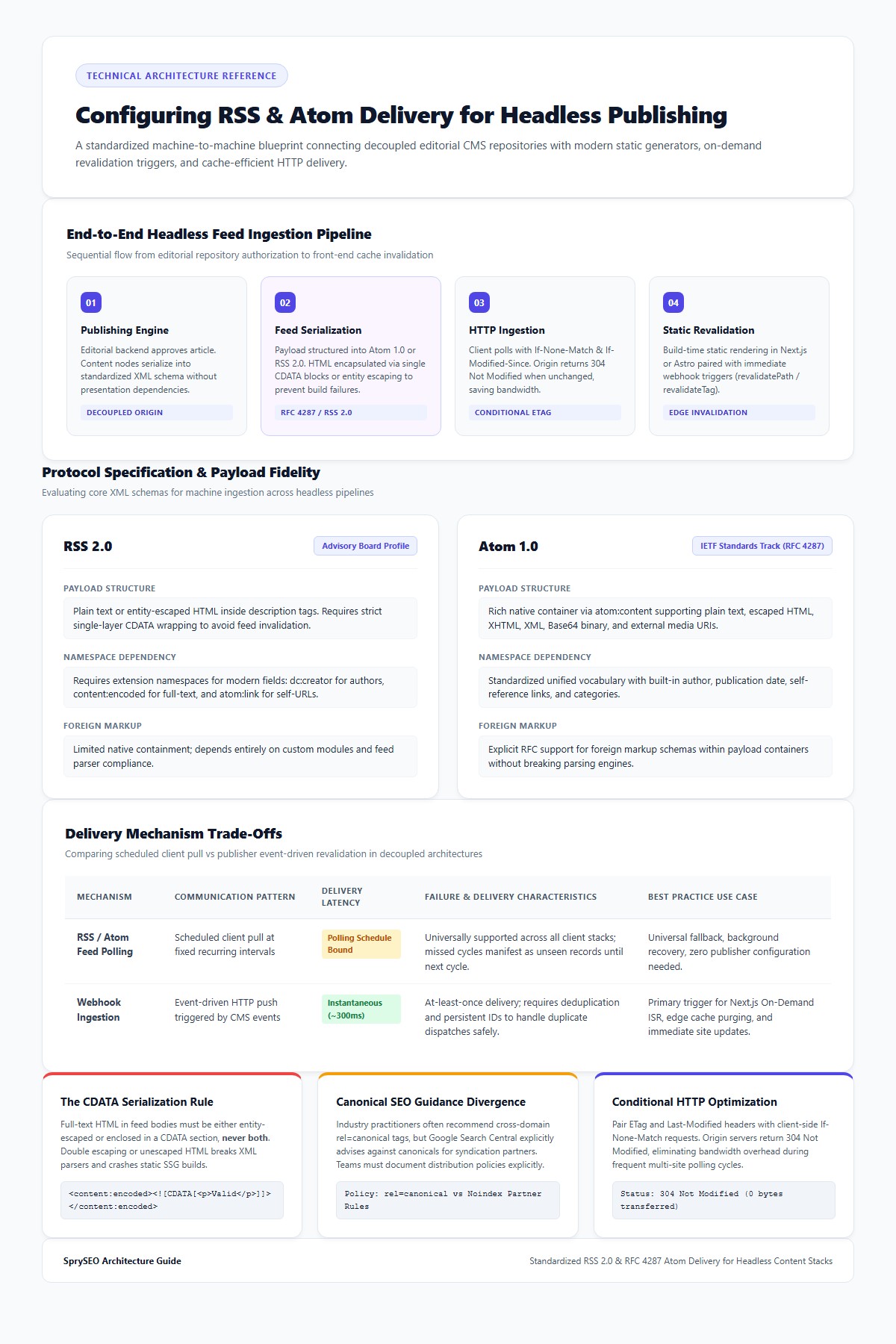
Specification Differences: RSS 2.0 vs. RFC 4287 Atom
Atom is standardized under RFC 4287 as an XML-based Web content and metadata syndication format on the IETF Standards Track. The RFC explicitly defines an XML markup vocabulary permitting foreign markup from other schemas, with the atom:content element designed to contain arbitrary structured data. RSS 2.0 is maintained via an advisory board profile and XML specification, relying heavily on modular extension namespaces for fields beyond its minimalist core.
Payload Fidelity and Foreign Markup
These design philosophies directly affect payload fidelity. While RSS payloads are limited to plain text or escaped HTML, Atom 1.0 accommodates plain text, escaped HTML, XHTML, raw XML, Base64-encoded binary data, and references to external media. For headless pipelines ingesting complete article bodies, Atom's native container elements eliminate the complex escaping maneuvers required when transporting complex rich text through RSS.
Extensibility with XML Namespaces: Dublin Core and Content Modules
RSS compensates for its constrained core specification through widely adopted namespace modules. Standard practice and feed parser libraries rely on namespaces such as Dublin Core (dc:creator) for author attribution, content:encoded for full-text HTML bodies, and atom:link for self-referencing URLs. When these namespaces are declared and validated properly, RSS delivers complete attribution and content. The distinction is that RSS requires explicit namespace layering, whereas Atom integrates these capabilities directly into its standard schema.
Protocol and Payload Comparison: RSS 2.0 vs. Atom 1.0 (RFC 4287)
| Feature / Dimension | RSS 2.0 | Atom 1.0 (RFC 4287) | Source Basis |
|---|---|---|---|
| Standard Type | Advisory Board Profile / XML specification | IETF Standards Track Protocol (RFC 4287) | RSS Advisory Board, RFC 4287 |
| Content Payload Support | Plain text or escaped HTML (via description or content:encoded) | Plain text, escaped HTML, XHTML, XML, Base64 binary, external references | CSS-Tricks, RFC 4287, RSS vs Atom analysis |
| Namespace Integration | Requires extension namespaces (e.g., Dublin Core dc:creator, content:encoded) | Core XML markup vocabulary with native foreign markup support (atom:content) | RSS Best Practices, RFC 4287 |
| Update Notification Mechanism | Scheduled client polling via HTTP XML requests | Scheduled client polling via HTTP XML requests | Stack Overflow, ByteByteGo |
Configuring Full-Text Delivery, Media Enclosures, and Metadata
Truncating feed items to brief excerpts undermines automated machine ingestion. Pipelines built for downstream publishing require complete, uncompressed content bodies and accurate metadata at the serialization stage.
Preserving Rich Text and Layouts with CDATA Blocks
Improper markup serialization is the primary cause of feed parsing failures. In RSS feeds, HTML embedded within description or content:encoded tags must be either entity-escaped or enclosed in a CDATA section, but never both. Inserting raw, unescaped HTML results in feed invalidation or elements appearing as unknown. These bugs routinely appear in custom CMS export templates and feed plugins that output unescaped rich text. Encapsulating raw HTML within CDATA blocks preserves nested tags, code blocks, and inline styling while maintaining XML compliance.

Structuring Media Enclosures for Responsive Featured Assets
Binary assets and featured imagery require explicit namespace handling to be parsed by downstream templates. Enclosures and media references sit outside base text nodes and should be declared within properly scoped namespaces alongside article bodies. Atom natively references external assets including documents, video, and audio streams, while RSS handles this through media extensions. Both patterns allow front ends to consume responsive media without stripping inline body assets.
Standardizing Author Attributes and Publication Taxonomy
Multi-author workflows and content categorizations require uniform taxonomy mappings. Declaring authorship through the Dublin Core dc:creator element and defining categories using explicit taxonomic schemas ensures predictable field mapping into receiving systems. Standardizing namespaces across all items eliminates ambiguity during parser ingestion.
Architecting Feed Ingestion Across Modern Web Frameworks
Consuming syndication feeds within contemporary front-end frameworks generally relies on two execution patterns: static build-time fetching or dynamic, on-demand cache revalidation.
Consuming Feeds in Build-Time Pipelines (Next.js, Astro)
Next.js enables build-time static generation using generateStaticParams, which iterates over route segments during the build phase rather than at runtime. During the build, the application fetches the feed, extracts the article nodes, and writes static HTML pages. Astro uses a comparable pattern via Content Collections, offering APIs to load, query, and render content from remote or live sources at build time or during live requests. Astro also supports feed generation through @astro/rss, allowing a single framework stack to ingest and publish syndication feeds.
Polling vs. Webhook-Triggered Revalidation
Build-time generation cannot reflect content published after the build completes without cache invalidation. Next.js handles this using on-demand Incremental Static Regeneration via revalidatePath or revalidateTag, purging cached routes across edge nodes when triggered by an incoming HTTP webhook. A robust implementation pairs scheduled polling for background recovery with immediate webhook-driven revalidation whenever the CMS publishes or updates an entry.
Optimizing Bandwidth and Latency with ETags and If-Modified-Since
High-frequency feed polling risks overloading origin servers if every request returns the entire payload. HTTP conditional headers prevent this overhead. The server returns validator tokens via ETag and Last-Modified headers, which clients echo in subsequent requests using If-None-Match and If-Modified-Since. If the feed has not changed, the server responds with 304 Not Modified, bypassing payload transfer and preserving client-side cache integrity.

Mitigating SEO and Ingestion Risks in Automated Feeds
Automating syndication introduces operational risks that valid XML syntax alone cannot resolve, particularly regarding search indexing and feed parsing stability.
Navigating Canonical Tag Conflicts Between Industry Advice and Google Guidelines
Syndication architectures encounter conflicting recommendations on cross-domain indexing. Many practitioners recommend adding cross-domain rel=canonical tags to preserve link equity and establish original authorship. Conversely, Google Search Central explicitly advises against using canonical link elements for content syndication partners, noting that syndicated variations often diverge too significantly for canonical consolidation. Teams must recognize this divergence and establish documented canonical policies for each distribution agreement rather than assuming universal behavior.
Handling Malformed XML and Schema Validation Errors
Malformed feeds cause fatal build errors in static site generators. A single unescaped entity or improperly closed tag in a rich-text field will cause the XML parser to fail. Adhering to the rule of either escaping entities or using CDATA encapsulation prevents markup from breaking downstream builds. Enforcing schema validation within the publishing pipeline intercepts invalid syntax before it reaches consuming applications.
Resolving Race Conditions in Staggered Multi-Site Deployments
When multiple downstream sites poll the same origin endpoint on differing schedules, updates propagate asynchronously. Missed polling cycles appear as missing records, and webhook delivery operates on an at-least-once model that periodically produces duplicate requests. Ingestion pipelines must be idempotent, utilizing unique, persistent article identifiers to deduplicate incoming entries and prevent inconsistent state across consuming sites.
Delivery Mechanism Trade-offs: Feed Polling vs. Webhooks in Headless Ingestion
| Mechanism | Communication Pattern | Delivery Latency | Failure & Delivery Characteristics | Source Basis |
|---|---|---|---|---|
| RSS / Atom Feed Polling | Scheduled pull by client at fixed intervals | Constrained by polling schedule | Universally supported without publisher tooling; missed updates look like unseen data | postrss, AppMaster, ByteByteGo |
| Webhook Ingestion | Event-driven push by publisher | Instantaneous (~300ms on-demand revalidation) | Requires publisher implementation; delivers at-least-once, requiring deduplication | postrss, Vercel, AppMaster, ByteByteGo |
Operationalizing Feed Health and Delivery Governance
A syndication endpoint functions as production infrastructure and requires formal operational governance, active monitoring, and clear service boundaries.
Automated Feed Health Monitoring and Endpoint Audits
Automated tests should continuously verify feed compliance, ensuring the endpoint outputs well-formed XML, that conditional requests trigger 304 responses when appropriate, and that body content remains fully rendered rather than truncated. Active endpoint monitoring detects serialization regressions before they interrupt production builds.

Establishing Delivery SLAs Between Editorial Engines and Frontends
Decoupled systems require defined operating parameters between content creators and engineering teams. Establishing explicit expectations for downstream update latency, defining the primary revalidation pathway, and documenting deduplication routines eliminates ambiguity. When polling cycles, webhook hooks, and error-handling steps are clearly defined, the content ingestion pipeline operates consistently.
Author Box
This guide was produced by the editorial team at SprySEO, an SEO and GEO content automation platform that connects website analysis, topic planning, AI article generation, SEO and GEO checks, and scheduled publishing. SprySEO helps content operations teams dispatch approved content to CMS platforms via webhooks or RSS/Atom/JSON feeds, making it well positioned to document the technical realities of structured syndication for headless stacks.
Disclaimer
This article is provided for informational purposes only and describes technical patterns and protocol behavior as of the sources referenced. Specifications, framework features, and search engine guidance change over time, and implementation details can vary across platforms. Always validate feed output, caching behavior, and SEO decisions against the current official documentation for your specific CMS, framework, and search provider before deploying to production.
Frequently asked questions