The Role of Factual Grounding in Generative Search Visibility
Why AI search engines favor articles with unambiguous statistics, cited authorities, and verifiable statements when compiling generative answers.

Factual grounding dictates visibility in generative search. Because AI answer engines deploy retrieval-augmented generation (RAG) to cross-reference web passages against authoritative external sources, they actively filter out hallucinations. Passages backed by unambiguous statistics, explicit entity relationships, and verified primary documentation score higher in algorithmic retrieval confidence. Consequently, engines prioritize them as cited authorities over subjective, unverified commentary.
Key Takeaways
- Grounding anchors answers to evidence. RAG couples a parametric language model with non-parametric external memory accessed at inference time. This setup constrains generation to verified context, minimizing hallucinations and surfacing direct citations.
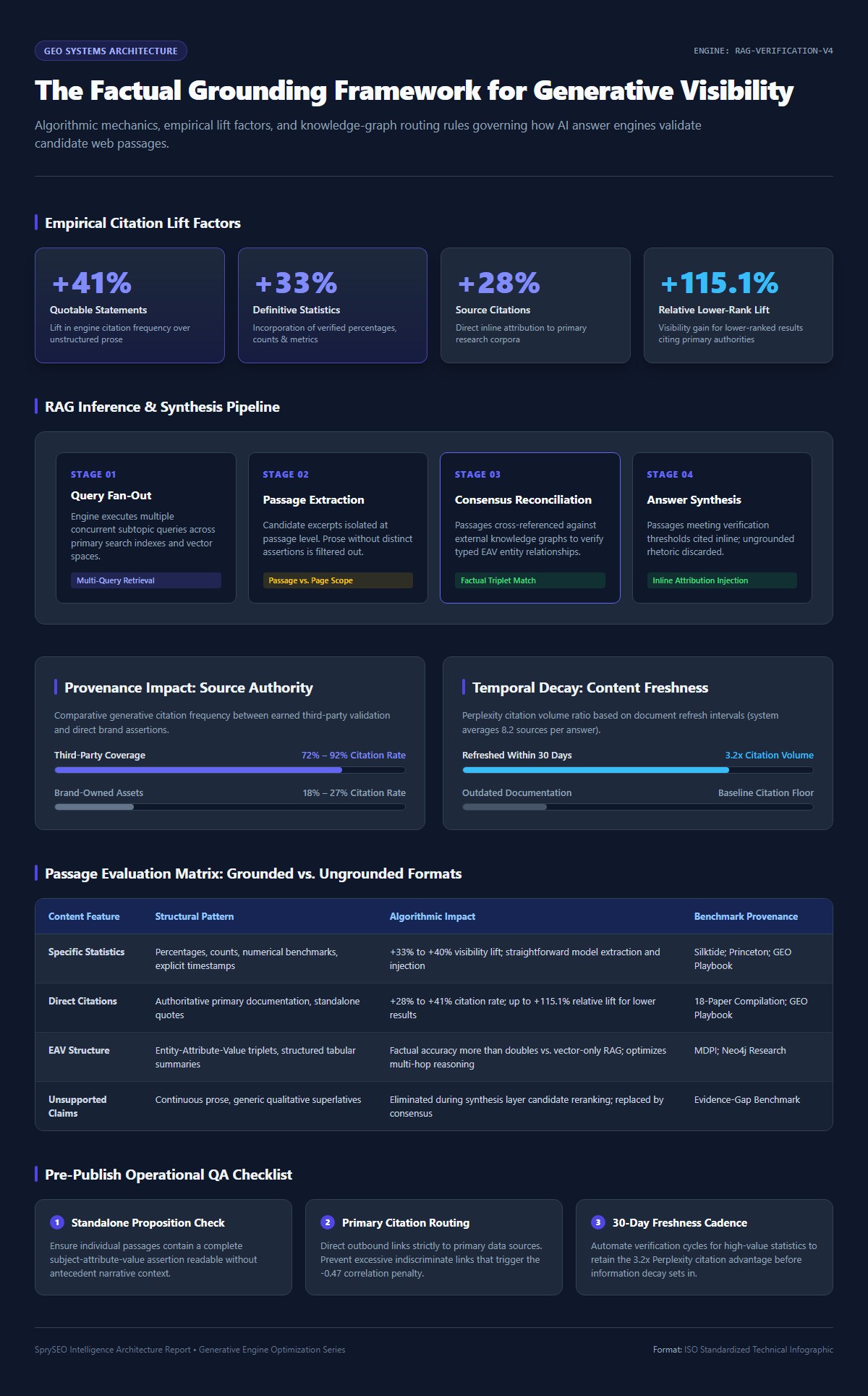
- Statistics and citations lift visibility. Controlled experiments show that quotable statements raise citation rates by +41%, statistics by +33%, and source citations by +28%, yielding up to a +115.1% relative lift for lower-ranked results that cite primary sources.
- Engines cite passages, not pages. If a passage lacks an independently citable proposition or conflicts with a more authoritative source, models drop it during synthesis.
- Structure beats prose. Entity-attribute-value (EAV) triplets and knowledge-graph architectures consistently surpass unstructured narrative in multi-hop extraction accuracy.
- Freshness and QA matter. Content refreshed within 30 days captures measurably higher citation volume, while systematic pre-publish verification protects generative reach.
Understanding Factual Grounding in Generative Search
Generative search engines have moved beyond ranking lists of links; they synthesize composite answers. Executing this reliably requires a verification mechanism that validates generated text against traceable evidence.
The Retrieval and Synthesis Loop: How Models Validate Retrieved Claims
Retrieval-augmented generation allows large language models to query external repositories at inference time rather than relying solely on frozen model weights. In practice, RAG architectures retrieve facts via search indexes, while vector databases surface contextually relevant documents across the pipeline.
Google defines grounding as a core mechanism to elevate the accuracy, freshness, and quality of AI responses by anchoring them in its primary search index. AI Overviews and AI Mode frequently use "query fan-out"—executing multiple subtopic queries simultaneously across diverse sources—and then systematically validate each synthesized statement against the retrieved source texts. This real-time reconciliation between model output and underlying evidence determines whether a source earns or loses a citation.
Parametric Memory vs. Grounded RAG Retrieval
Hallucinations generally trace back to parametric bias: models default to internal training weights unless external guardrails force them elsewhere. Grounding decouples the generation process from internal memory by externalizing factual data into vector stores or knowledge graphs, requiring the model to cite retrieved records directly before generating an answer.
This operational shift changes publisher visibility. When an engine operates strictly on parametric memory, your content carries no active weight. When it executes grounded retrieval, your passages serve as primary candidate evidence—provided they contain explicit, extractable assertions.
Why Hallucination Penalties Suppress Ungrounded Web Sources
When a candidate passage lacks a distinct, verifiable fact—or if its premise conflicts with higher-authority corpora—the synthesis engine drops it. Sources providing specific, verifiable facts receive inline citations; passages with zero extractable data or conflicting assertions are eliminated during candidate reranking. Ungrounded narrative is not simply overlooked—the synthesis layer actively filters it out.

The Anatomy of Citation-Worthy Factual Content
Retrieval performance varies significantly across content types. Empirical GEO research highlights specific structural patterns separating frequently cited passages from ignored ones.
Unambiguous Statistics and Measurable Benchmarks
Princeton's Generative Engine Optimization research confirms that specific factual optimizations—incorporating statistics, verifiable citations, and hard data points—boost visibility in generative engines by up to 40%. Aggregated data from multiple controlled experiments reinforces this: adding statistics increases citation rates by +33%, while quotable statements deliver a +41% lift.
The underlying model dynamics explain this behavior. Presented with clear data points, language models show a measurable bias toward generating quantitative claims and incorporating input metrics directly into answers. Exact numbers give the model definitive, unambiguous anchors to ground on and replicate.
Clear Entity-Attribute-Value Relationships vs. Unstructured Narrative
Information architecture dictates machine extraction efficiency. Structuring data as entity-attribute-value (EAV) triplets enables models to map facts cleanly into explicit schemas, outperforming continuous prose in attribute lookups and multi-hop reasoning.
The vector retrieval architecture clarifies why this occurs. Standard vector RAG assesses passages based on semantic similarity rather than factual relationships, which frequently fails when reconciling distributed facts. Conversely, graph-oriented frameworks that organize knowledge into structured entities and typed relationships more than double factual accuracy while preserving direct source provenance. Vector search struggles to resolve multiple non-contiguous facts because it prioritizes semantic proximity over logical association; knowledge-graph grounding resolves that gap.

Attribution Protocols: Linking Claims to Primary Authorities
Source-led content organizes its premise around primary data, verifiable facts, and source attribution, giving engines the evidentiary backing required to generate citations. The performance delta is substantial: referencing primary sources drives a +115.1% relative visibility gain for lower-ranked results, and incorporating source citations alone boosts citation frequency by +28%. Furthermore, third-party coverage captures citations 72–92% of the time, compared to just 18–27% for brand-owned assets—confirming that earned, objective verification carries far greater algorithmic weight than promotional content.
Comparative Framework: Ungrounded vs. Grounded Content
| Content Feature / Pattern | Implementation Form | Observed AI Retrieval & Citation Impact | Evidence Source |
|---|---|---|---|
| Specific statistics | Percentages, counts, benchmarks, timestamps | Visibility lift of +33% to +40%; easier model extraction and injection into answers | Silktide; 18-paper compilation; Princeton; GEO Playbook |
| Direct citations & quotations | Authoritative primary sources, quotable statements | Citation rate up +28% to +41%; up to +115.1% relative lift for lower-ranked results | 18-paper compilation; Princeton; GEO Playbook |
| Entity-attribute-value structure | Explicit triplets, tabular attribute matching | Improves multi-hop reasoning and attribute retrieval; factual accuracy more than doubles vs. vector-only | MDPI; Neo4j |
| Unsupported vague claims | Prose that names entities but lacks direct evidence | Dropped during synthesis or overwritten by more credible sources | Evidence-gap benchmark; GEO Playbook |
Why AI Engines Ignore Rhetoric and Prioritize Verifiable Claims
Generative engines systematically prioritize factual substance over unverified stylistic copy. Analyzing how this filtering occurs informs better content design.
The Failure of Fluff: Qualitative Claims vs. Concrete Evidence
Subjective qualitative claims are routinely culled during synthesis. AI engines prioritize content demonstrating measurable research rigor and strong factual foundations; every passage should therefore establish at least one independently citable proposition—whether a precise statistic, a concrete definition, or a verified metric. Claiming a platform is "industry-leading" offers no usable extraction data; detailing an empirical benchmark provides an immediately usable fact.
Consensus Verification Across the Broader Knowledge Graph
Because generative engines reconcile synthesized outputs against source documents, claims matching external consensus survive, while unsupported single-source claims drop out. A primary shortfall of similarity-based search is its reliance on semantic proximity, meaning text that merely sounds authoritative can be retrieved. Knowledge-graph grounding counters this by validating typed relationships and confirming provenance back to the source node.
How Ambiguity Lowers Passage Extraction and Reranking Confidence
Pre-generation evidence research confirms that semantic relevance does not guarantee evidentiary value. Retrieved candidate passages frequently mention the target entities without delivering the underlying facts required to answer the prompt. Benchmarks isolating answer support from surface-level vocabulary demonstrate that reranking sufficient evidence above insufficient evidence is an independent, measurable step in modern pipelines. Passages that merely reference an entity without supplying the supporting data point are systematically deprioritized.
Formatting Information for Seamless LLM Extraction
While grounding determines whether a claim is citation-worthy, structural formatting determines whether automated scrapers and parsers can locate it. Machine-readable structure serves as a critical operational lever.
High-Density Comparison Tables and Tabular Summaries
Tables expose entity attributes in a transparent format that parsers digest effortlessly, binding attributes directly to entities and removing semantic ambiguity. By mirroring the EAV structures that routinely beat raw text in attribute extraction, comparative tables allow synthesis models to extract and reproduce facts intact.
Self-Contained Factual Sentences and Definitive Hooks
Engines evaluate and cite individual passages rather than entire documents, meaning every excerpt must function independently. Draft sentences that communicate an entire, verifiable proposition without relying on antecedent narrative. A standalone factual statement—containing a defined subject, a measured attribute, and an absolute value—is primed for automated citation. Definitive reference formats that isolate the identity, scope, or attributes of a concept serve this exact parsing requirement.
Schema Markup and Machine-Readable Claim Encodings
Aligning text with structured entity schemas, distinct identifiers, and formal markup reinforces the entity-resolution layers within AI search engines. Implementing explicit schema and consistent entity nomenclature helps models disambiguate context, increasing retrieval confidence when scoring passages for citations.

Resolving the Attribution Dilemma: External Links vs. Algorithmic Trust
The relationship between outbound links and generative visibility presents a nuanced operational trade-off that requires careful management.
Navigating the Data: Citation Gains vs. Excessive External Link Penalties
The data reveals an apparent contradiction. Pointing to authoritative sources produces major visibility advantages: content housing statistics, verified citations, and authoritative quotes records visibility gains up to 40%, scaling between +28% and +115.1% for citation-dense excerpts. Conversely, a broad correlation study spanning tens of thousands of queries across eight industries uncovered a -0.47 negative correlation between high external link ratios and overall AI visibility.
This tension resolves around citation precision. Measurable gains stem from targeted, authoritative references that provide semantic validation; the visibility penalty corresponds to excessive link ratios and low-value outbound linking. The operational rule is straightforward: link directly to primary documentation where assertions require empirical backing, and avoid packing content with indiscriminate links.
Managing SOTA Model Over-Summarization and Context-Aware Factuality Limits
Even mature grounding architectures encounter limitations. Evaluated on the GaRAGe benchmark—encompassing human-curated long-form responses and over 35,000 annotated passages across 2,366 queries—leading models routinely over-summarized source inputs instead of strictly grounding outputs in annotated passages, topping out at a Relevance-Aware Factuality Score of 60%. Models frequently smooth over granular evidentiary details to produce shorter summaries. Content teams must therefore construct core facts to be maximally explicit and self-contained, ensuring primary data survives automated summarization.
Balancing Proprietary Research with Established Industry Facts
Referencing primary third-party documentation does not undercut domain authority; it supplies the semantic corroboration models need to validate proprietary assertions. The most effective strategy pairs unique, proprietary data—the foundation for third-party citations—with explicit references to accepted industry baselines, supplying search engines with both novelty and verified consensus.
Operationalizing Factual QA in Publishing Pipelines
Factual grounding is a systematic workflow that must be integrated directly into content operations to preserve visibility at scale.
Pre-Publish Fact-Checking Gates and Claim Verification Audits
Editorial workflows should enforce a technical pre-publish QA checklist verifying schema integrity, citation accuracy, and passage extraction viability. Instituting a pre-publish gate that maps assertions to underlying sources—while flagging instances where entities are named without empirical backing—stops ungrounded text from reaching the CMS, where generative models would discard it anyway.

Automating Schema and Extraction Readiness Checks
Mechanical auditing tasks, such as link verification and schema validation, should be automated via custom scripts or editorial toolchains rather than left to manual review. Programmatic auditing guarantees that all published assets meet machine-extraction requirements consistently across enterprise-scale libraries and international setups.
Monitoring Citation Health and Mitigating Information Decay
Content freshness operates as a quantifiable retrieval signal. B2B citation benchmarks indicate that assets refreshed within 30 days capture 3.2x more citations in Perplexity compared to outdated URLs. Perplexity maintains an overall citation rate of 13.05% and averages 8.2 cited sources per response. Editorial teams must actively audit citation health, updating dated statistics before visibility drops and treating fact maintenance as a core, continuous editorial discipline.
Author Box
This article was prepared by the editorial team at SprySEO, an SEO and GEO content automation platform. SprySEO connects website analysis, topic planning, AI article generation, built-in SEO and GEO checks, and scheduled publishing to help brands earn visibility in both search engines and AI answer engines. The team specializes in multi-site and multilingual content planning, structured publishing automation, and editorial governance workflows for content operations managers, SEO specialists, and digital marketing teams.
Disclaimer
This content is provided for informational purposes only and reflects research findings and benchmark data available at the time of writing. Generative search algorithms, ranking factors, and citation behaviors evolve rapidly across engines and may vary by query, vertical, and region. The metrics cited here are drawn from the referenced studies and controlled experiments and should not be interpreted as guaranteed outcomes for any specific website. Validate strategies against your own data and current platform documentation before making operational decisions.
Frequently asked questions