Navigating Generative Search: Strategic Content Planning for Modern Brands
Prepare your digital marketing strategy for the future of search by combining foundational SEO best practices with generative engine optimization techniques.

Generative search replaces rank-and-click listings with synthesized answers, slashing position 1 click-through rates by 52% and pushing zero-click rates past 74%. For modern brands, winning visibility now requires shifting from keyword targeting to entity authority and Generative Engine Optimization (GEO) to capture model citations. Competing for ten blue links is no longer sufficient on a search surface where large language models ingest, summarize, and cite content before a user ever reaches an external page.
Data from 2026 highlights this clear erosion of traditional organic performance alongside the emergence of AI citations as a primary discovery channel. For content operations managers, SEO strategists, and digital marketing leaders, the mandate extends beyond ranking: brands must become the trusted sources that AI engines reference. This guide establishes a practical transition framework connecting empirical benchmarks, technical execution, and editorial governance.
Key Takeaways
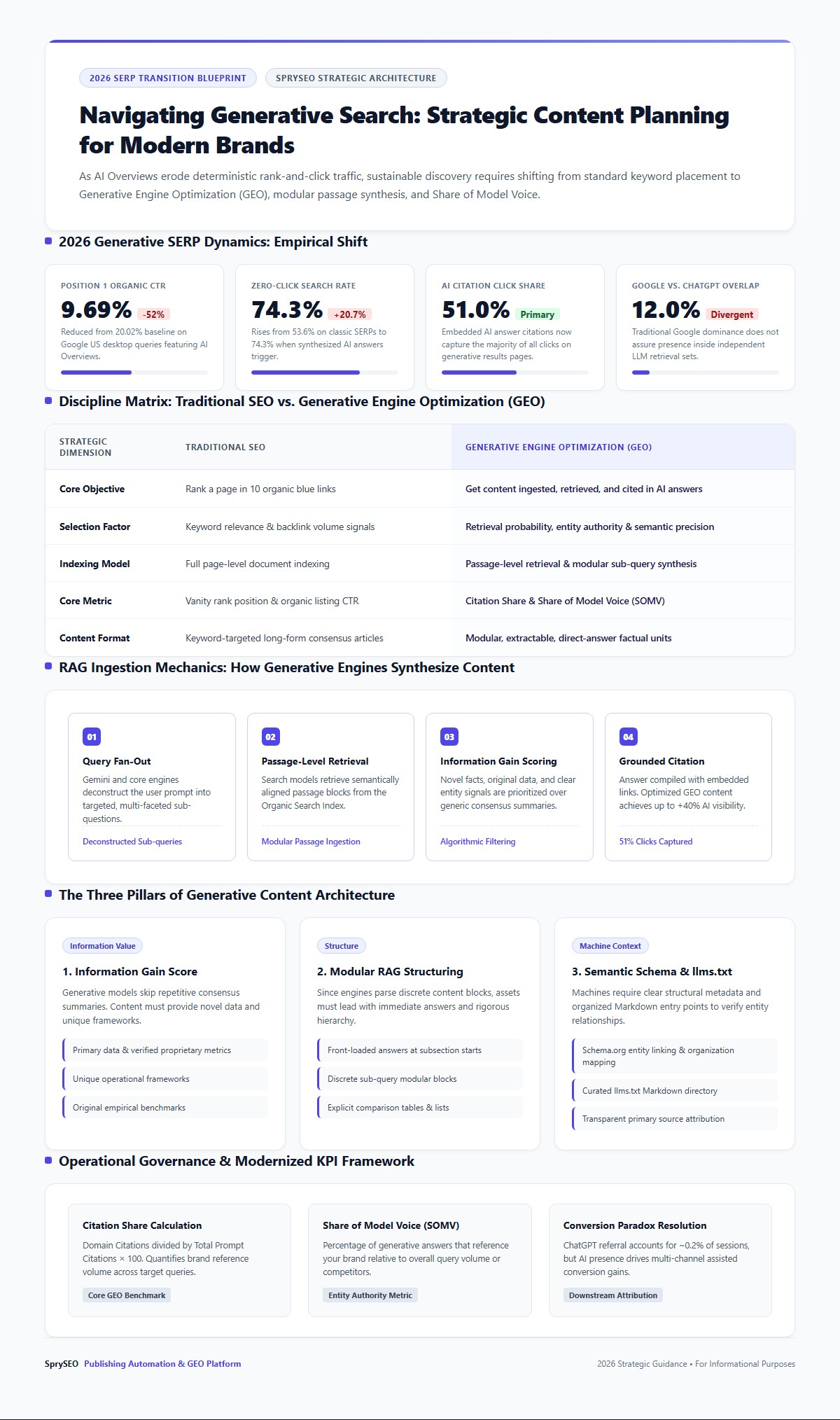
- AI Overviews cut position 1 organic CTR by 52% (falling from 20.02% to 9.69%) and lifted zero-click search rates to 74.3% when triggered.
- AI answer citations capture 51.0% of all clicks on generative results pages, establishing citations as the primary discovery vector.
- GEO shifts optimization from keyword position to retrieval probability and AI citations, reinforcing rather than replacing baseline SEO.
- Search results between Google and ChatGPT show only a 12% overlap, meaning traditional organic dominance does not assure AI visibility.
- Entity authority, high Information Gain, structured Schema.org markup, and llms.txt configurations serve as the foundation of citation-ready publishing.
- Performance tracking now requires swapping vanity rankings for Citation Share and Share of Model Voice (SOMV).
The Reality of Generative Search: 2026 SERP Dynamics and Traffic Shifts
The mechanics of user discovery have permanently altered. Synthesized answers positioned prominently at the top of search result pages dictate whether, when, and how traffic ever visits a brand's web properties.
Impact of AI Overviews on Position 1 CTR and the 74.3% Zero-Click Benchmark
Click behavior reveals the clearest operational impact. As of July 2026, the deployment of AI Overviews reduced position 1 organic click-through rates by 52%, dropping from 20.02% down to 9.69% across Google US desktop queries. Concurrently, zero-click rates reached 74.3% on pages featuring an AI Overview, compared to 53.6% on traditional SERPs.
This gap transforms search value: securing the top organic listing now yields roughly half the traffic it previously generated. Most searches triggering an AI Overview conclude without the user visiting any third-party domain.
The Rise of AI Citations: Capturing 51% of Clicks on Generative SERPs
Rather than disappearing entirely, search traffic is consolidating around answer interfaces. During the second quarter of 2026, AI answer citations overtook traditional organic listings as the largest single contributor to discovery clicks. Where an AI answer appears, embedded citations capture 51.0% of total page clicks.
This shift redefines editorial priorities. An in-answer link now offers significantly more commercial value than a lower-tier organic placement. Citation placement is no longer an ancillary benefit—it is the central mechanism of search visibility.

How Search Engines Synthesize Answers: Gemini, Query Fan-Out, and RAG Ingestion
Search architecture dictates content strategy. Google AI Overviews leverage the Gemini large language model, the core Organic Search Index, and a query fan-out system. This fan-out framework deconstructs a user prompt into targeted sub-questions, retrieves semantically aligned passages to address each fragment, and compiles a grounded answer.
Consequently, search engines evaluate content at the passage level rather than the document level. If an article lacks modular, self-contained sections that answer discrete sub-queries directly, it risks exclusion from the synthesis regardless of domain authority or overall page quality.
SERP Impact of AI Overviews vs. Traditional Results (2026)
| Metric / Dimension | Without AI Overview | With AI Overview / AI Citations |
|---|---|---|
| Position 1 Organic CTR | 20.02% | 9.69% (52% reduction) |
| Zero-Click Search Rate | 53.6% | 74.3% |
| Share of Total Discovery Clicks | Majority captured by organic links | 51.0% captured by AI answer citations |
Traditional SEO vs. Generative Engine Optimization (GEO)
GEO represents a distinct discipline built on different selection criteria and metrics, though it remains anchored to technical SEO hygiene.
From Keyword Ranking to Retrieval Probability and Ingestion Readiness
Traditional SEO aims for a deterministic outcome: rank placement on a search results page. GEO focuses on a probabilistic objective: the likelihood that an engine retrieves and cites a specific passage inside an answer. In generative environments, retrieval probability supersedes keyword density—clarity, structure, and semantic precision determine selection.
Ingestion readiness is therefore paramount. Content must be structured and semantically explicit so machine retrieval systems can parse and extract clean factual statements with high confidence.
The 12% Overlap Reality: Why Winning Google Does Not Guarantee AI Citations
High organic rankings on Google do not guarantee presence in generative systems. Empirical comparisons show only a 12% overlap between the sources displayed by Google search results and those surfaced by ChatGPT. The two systems rely on independent retrieval heuristics.
This divergence highlights an untapped opportunity rather than a replacement strategy. A site dominating classic organic rankings may remain invisible across AI answers, and the reverse is equally true. Managing visibility requires targeted execution across both formats.
Entity Authority vs. Backlink Volume in Modern Model Training
GEO builds on technical organic health rather than discarding it. Where SEO supplies crawlability, indexing, and baseline authority, GEO optimizes for entity recognition and citation relevance. Modern engines prioritize how definitively a brand functions as a recognized authority within its subject domain over sheer backlink volume. Content tailored for generative engines can improve visibility in AI responses by up to 40%, proving that dedicated GEO workflows produce tangible incremental gains over standard SEO.
Comparative Matrix: Traditional SEO vs. Generative Engine Optimization
| Dimension | Traditional SEO | Generative Engine Optimization (GEO) |
|---|---|---|
| Core Objective | Rank a page in the results list | Get content retrieved and cited in AI answers |
| Selection Factor | Keyword relevance and ranking signals | Retrieval probability and entity authority |
| Indexing Model | Page-level indexing | Passage-level retrieval and synthesis |
| Core Performance Metric | Rankings and organic CTR | Citation Share and Share of Model Voice |
| Content Structure | Keyword-targeted pages | Modular, extractable, direct-answer passages |
Pillars of Generative Content Architecture: Information Gain and Modular Structuring
Capturing generative citations demands an editorial architecture built for algorithmic extraction and synthesis. Three core components define ingestion readiness.
Information Gain Score: Bypassing Generic Consensus Summaries
The Information Gain Score quantifies the depth of novel information a page offers relative to current SERP results, penalizing repetitive summaries. Generative models have no reason to cite content that merely restates existing web consensus. Pages rehashing common knowledge are skipped in favor of primary, high-information-gain assets.
This reality reshapes editorial briefs. Instead of merely asking whether a topic is covered comprehensively, teams must determine what original data, proprietary research, or unique operational frameworks the piece contributes to the web index.
Structuring Content for RAG Parsing: Heading Hierarchy, Key Facts, and Direct Answers
Because query fan-out engines index discrete content blocks, editorial assets must be formatted into clean, extractable modules. A clear heading structure, direct topic sentences, and focused paragraphs answering individual questions materially increase retrieval rates.
Content should lead with the answer. Front-load conclusive data and direct answers at the beginning of each subsection. Tables, bullet points, and defined schemas should be structured so models can extract factual data without parsing ambiguity.

Machine-Readable Context: Schema.org Entities and llms.txt Configuration
Structured markup provides explicit context to machine parsers. Implementing Schema.org entity linking allows generative systems to map your organization, its subject-matter associations, and semantic relationships across topics, bolstering overall entity authority.
The deployment of llms.txt serves as an essential complement. While robots.txt manages crawler access, an llms.txt file directs AI systems to clean, Markdown-formatted summaries of key content assets. This file acts as a structured roadmap, routing models directly to your most authoritative, citation-ready documentation.
Operationalizing the Generative Content Workflow for Modern Editorial Teams
A strategic framework requires changes to daily publishing operations, updating how marketing and SEO teams evaluate topics, produce briefs, and manage quality.
Auditing Legacy Content for Citation Eligibility and Semantic Gaps
Content audits must begin with the existing archive. Many legacy articles prioritize keyword density over extractable facts and modular answers. Editorial teams should identify and flag pages relying on consensus summaries or lacking clear factual takeaways.
Prioritize updating high-value commercial and informational URLs. Refactor sections to resolve specific sub-queries, integrate proprietary data points to boost Information Gain, and clarify entity relationships within the copy.
Fact-Verification and Primary Source Attribution Protocols
Generative engines index and cite verifiable, well-attributed information. Publishing unverified claims or inaccurate data risks exclusion from retrieval sets. Editorial workflows should incorporate strict review stages checking human and AI-assisted drafts against internal standards and factual references.
Enforce direct attribution to primary sources for every statistic and factual assertion. Clear citation paths protect editorial integrity while strengthening algorithmic trust signals during retrieval evaluation.

Balancing Public Citation Indexing with Proprietary Data Protection
Content leaders face an operational tension between shielding proprietary intelligence and enabling AI discovery. Blocking all web scrapers safeguards intellectual property but eliminates the brand from generative answers. Conversely, utilizing llms.txt deliberately provides models with structured summaries for citation.
The solution lies in intentional tiering. Apply crawler blocks to internal documentation, gated research, and proprietary databases, while leveraging llms.txt to surface the public, authoritative assets intended for generative indexing and citation.
Measurement and KPI Modernization for the AI-First Web
New discovery formats require modernized measurement frameworks. Traditional rank tracking misses the downstream impact of synthesized AI answers.
Calculating Citation Share and Share of Model Voice (SOMV)
Two primary metrics evaluate performance across generative search interfaces:
- Citation Share: Calculated as your domain's citations divided by total citations across a defined prompt set, multiplied by 100, tracking the proportion of model references your brand controls.
- Share of Model Voice (SOMV): The percentage of generative answers that reference your brand relative to overall query volume or identified competitors.
Benchmarking these metrics against standardized prompt sets demonstrates whether content optimizations are increasing brand inclusion across generative search over time.

Addressing the Conversion Paradox: Lower Raw Referral Volume vs. Higher Multi-Channel Lead Quality
The business impact of AI search on conversions requires nuanced analysis. Community reporting indicates ChatGPT referral traffic accounts for roughly 0.2% of total website sessions—a fraction of Google organic—with lower direct conversion rates than standard organic search.
However, top-line referral volume provides an incomplete picture. Organizations tracking drops in direct organic clicks alongside increases in AI visibility frequently observe gains across downstream channels, including improved direct-traffic conversion rates and higher overall volumes of qualified leads. GEO must be evaluated through assisted, multi-channel attribution. Presence within generative answers builds topical authority and brand awareness that convert downstream via higher-intent channels.
Sustainable organic strategies abandon legacy vanity metrics to measure the full, distributed value of being the cited authority across AI answer engines.
Author Box
This article was produced by the editorial team at SprySEO, an SEO and GEO content automation platform that connects website analysis, topic planning, AI article generation, SEO and GEO checks, and scheduled publishing. The team focuses on helping content operations managers, SEO specialists, and digital marketing teams gain visibility across both traditional search engines and AI answer engines through structured, citation-ready content workflows.
Disclaimer
This content is provided for informational purposes only and reflects generative search dynamics and benchmarks reported as of 2026. Search engine and AI answer engine behavior, metrics, and technical standards evolve rapidly; figures and practices described here may change. Readers should validate current benchmarks and platform requirements against primary sources before making strategic decisions.
Frequently asked questions