Structuring FAQ and Q&A Content for Direct Search Engine Answers
Create concise, query-focused question-and-answer sections within articles to capture conversational search terms and expand generative engine visibility.

To win direct search engine answers, pair naturally phrased, query-focused headings with immediate, self-contained 40-to-60 word declarative answers before unpacking deeper context. Eliminating opaque accordion scripts, maintaining valid structured data, and grounding responses with explicit entity-attribute data produces extractable semantic chunks optimized for both traditional featured snippets and generative engine synthesis.
Key Takeaways
- Lead every Q&A with an answer-first core of 40 to 60 words directly beneath a question heading, then expand; definition featured snippets average 40 to 60 words, an ideal window for AI extraction.
- For question-based AI retrieval, explicitly formatted Q&A chunks perform best at 75 to 150 words; structure-aware RAG chunking typically spans 300 to 800 tokens with 10 to 20% overlap to keep each question-and-answer pair intact.
- Eliminate JavaScript-only accordions: when answers are missing from initial HTML and populate only on user interaction, search engine crawlers cannot parse them.
- Google fully discontinued SERP FAQ rich results on May 7, 2026, but FAQPage remains a valid Schema.org type utilized by LLMs and AI Overviews for structural parsing.
- Standalone FAQ pages consolidate category-level authority, whereas embedded Q&A modules strengthen passage retrieval but carry risks of cannibalization across topic clusters.
The Evolution of Q&A Content: From Static Accordions to Retrieval Targets
Q&A content has evolved from a cosmetic layout component into a core retrieval target. Explicit question-and-answer pairs allow modern answer engines to isolate, evaluate, and extract specific passages without reinterpreting surrounding context. Clean structural design is no longer an editorial preference; it is a search performance requirement.
Why Legacy Accordion Widgets Create Parsing Friction for Modern Crawlers
Dynamic FAQ accordions that inject content via JavaScript only after click interactions remain completely invisible to Google crawlers. If the accordion container is empty in the initial server-rendered HTML, search bots miss the content entirely. This architectural failure occurs frequently across React and Vue applications that hydrate FAQ data through asynchronous CMS API calls. Hiding substantive copy behind client-side toggles compromises indexing and breaks RAG chunking pipelines. Rendering complete answers directly into semantic HTML on first load resolves this friction.
How RAG Vector Pipelines Ingest and Tokenize Question-and-Answer Chunks
Retrieval-augmented generation pipelines process documents by segmenting text into chunks, generating vector embeddings, and surfacing high-relevance passages. Separating a question heading from its corresponding response degrades retrieval quality: an isolated question contains no resolution, while an orphaned answer often lacks critical framing. Document-aware chunking that preserves the Q&A unit intact yields the highest context retention. Maintain structure-aware recursive splitting between 300 and 800 tokens with a 10 to 20% overlap, retaining parent headings as metadata and keeping data tables and code blocks fully intact.

The Dual Objective: Traditional Featured Snippets and Generative Answer Citations
Modern Q&A formatting must address two search interfaces simultaneously. Traditional featured snippets pull an extracted excerpt from a single qualifying URL. Conversely, Google AI Overviews synthesize multi-source material into a composite summary, distributing citations across multiple domains. Content structured for direct extraction while maintaining technical authority fulfills the requirements of both paradigms.
Anatomy of a Direct Answer: The Answer-First Formatting Framework
The most extractable on-page architecture pairs an unambiguous query directly with an immediate response: establish the core answer upfront, then provide supporting technical context.
The Inverted Pyramid Pattern: Crafting the 40-to-60 Word Core Answer
The inverted pyramid approach places the primary takeaway in the opening sentence, followed by operational detail, contextual constraints, and technical evidence. Large language models assign disproportionate weight to paragraph openings during passage retrieval. Semrush data reveals that definition featured snippets average 40 to 60 words—a concise boundary that enables AI systems to extract precise facts without hallucinations. Frame the initial one or two sentences as the definitive answer before expanding the section.

Formulating Query-Targeted Subheadings with Natural Conversational Phrasing
Maintain a strict hierarchy: designate an H2 for the overarching section, individual H3 tags for specific questions, and clean paragraph blocks for direct responses. Frame subheadings around natural search queries rather than internal marketing jargon. Using H2 or H3 structures framed as "What is X?" or "How to Y?" followed by a concise answer establishes predictable semantic nodes. Support these units with modular thematic blocks of roughly 200 to 400 words to resolve related sub-questions.
Supporting Declarative Answers with Structured Data and Contextual Proof
Follow the lead answer with scannable technical support. Formatting secondary explanations into concise lists or data tables increases citation capture rates within AI engines over continuous text blocks. For question-based retrieval, dedicated Q&A chunks perform best between 75 and 150 words. Combining a 40-to-60 word lead answer with concise structural context addresses both standard featured snippets and generative response engines.
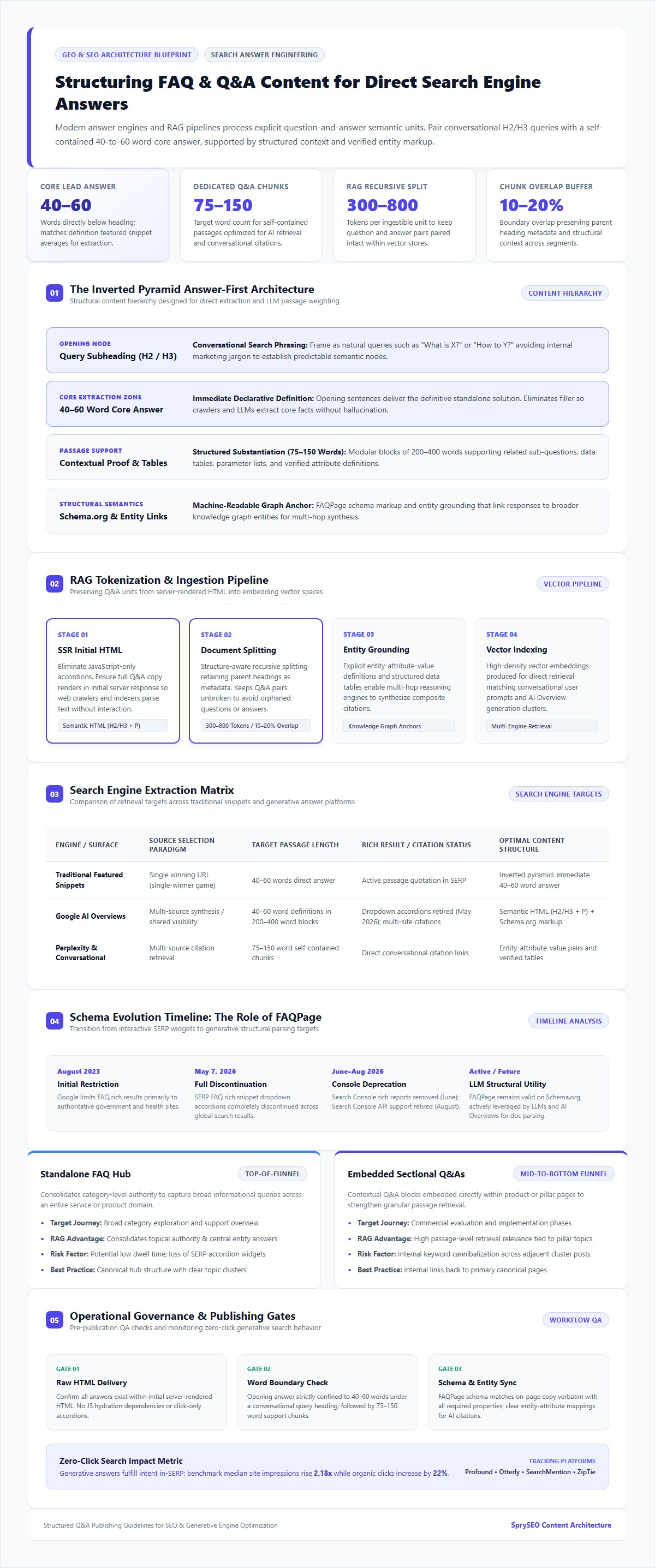
| Feature / Parameter | Traditional Featured Snippets | Google AI Overviews | Perplexity / Conversational Engines | Optimal Content Structure |
|---|---|---|---|---|
| Source Selection | Single winning URL / single-winner game | Multi-source synthesis / shared visibility | Multi-source citation retrieval | Explicit Q&A pairs with verified entity facts |
| Target Passage Length | 40–60 words direct answer | 40–60 word definitions within 200–400 word modular blocks | 75–150 word self-contained chunks | Answer-first 40–60 words followed by supporting context |
| SERP Rich Result Status | Active passage quotation | FAQ rich snippet dropdowns discontinued (May 2026); synthesizes multi-source answers | Direct conversational citation generation | Clean semantic HTML (H2/H3 + P) plus Schema.org markup |
| Click Behavior | Higher single-site CTR | Elevated zero-click search share | Direct citation links with condensed click-through | Inverted pyramid with descriptive anchor links |
Technical Enablement: Schema Markup and Entity Grounding
Structured markup and clear entity relationships explicitly define the contextual meaning of Q&A content for search engine parsers.
Navigating FAQPage Schema Utility After Google's 2026 SERP Rich Result Discontinuation
Google limited FAQ rich results to selected government and healthcare websites in August 2023 before fully deprecating them on May 7, 2026. Rich result performance reports disappeared from Search Console in June 2026, followed by the retirement of Search Console API support in August 2026. Consequently, FAQ schema no longer triggers interactive SERP dropdown accordions. Even so, FAQPage remains an active Schema.org specification that helps AI platforms and AI Overviews interpret document structure. Existing schema implementations should be maintained rather than stripped. Under Google's structured data standards, ensure all required properties are populated, embed markup on the referenced page, and reflect actual on-page copy accurately.
Connecting Answer Entities to Knowledge Graphs via Semantic Markup
Search architecture relies on entity mapping over simple string matching, structuring information around people, organizations, products, technical concepts, and their interrelationships. Organizing Q&A content around explicit entities, unambiguous attributes, and verified source facts enables retrieval engines to ground your material accurately within broader knowledge graphs.

HTML Hygiene: Eliminating Bloated JavaScript Wrappers Around FAQ Blocks
Because client-side accordions frequently obscure text from crawlers, prioritize clean semantic HTML: place the question in an H2 or H3 heading and follow it immediately with a paragraph answer inside the initial server response. This ensures indexability across traditional web crawlers and RAG data pipelines while leaving room for progressive interactive enhancements.
Content Architecture: Dedicated FAQ Pages vs. Contextual Article Q&As
The placement of Q&A content determines its indexing role and alignment with the search journey.
When to Build Dedicated Hub FAQs vs. Embedded Sectional Q&A Modules
Dedicated hub pages and contextual Q&A modules address distinct structural requirements. A standalone FAQ hub aggregates category-level authority to capture broad top-of-funnel informational searches. Contextual Q&A blocks embedded inside product, solution, or pillar pages strengthen passage-level extraction, resolving mid-funnel evaluation criteria and technical implementation queries.
| Content Architecture | Target User Journey | Search Intent Alignment | RAG Ingestion Advantage | Risk Factor |
|---|---|---|---|---|
| Standalone FAQ Hub | Broad category exploration and support overview | Category-level informational queries | Consolidates topical authority and central entity answers | Potential low dwell time; deprecation of SERP accordion snippets |
| Embedded Sectional Q&A | Evaluation, decision, and implementation phase | Specific commercial and mid-funnel transactional queries | Provides granular, passage-level retrieval tied to pillar topics | Internal keyword cannibalization across adjacent cluster articles |
Preventing Cross-Page Cannibalization Across Similar Question Clusters
Keyword cannibalization happens when multiple URLs target matching intents, splitting ranking signals and confusing search engine canonical selection. Duplicating standard FAQ sets across multiple cluster articles dilutes domain authority. Mitigate this risk by consolidating overlapping sections, applying proper 301 redirects or canonical tags, and aligning every page with a unique user query. Anchor text discipline within internal linking is essential: link contextually related articles back to the primary canonical page and establish clear topic clusters anchored by central pillar pages.
Structuring Entity-Attribute-Value Pairs for Multi-Hop Conversational Discovery
Multi-hop query engines answer complex questions by correlating multiple sources, mapping entity attributes, and executing cross-document relational queries. Structuring your responses with clear entity-attribute-value definitions, data comparison tables, and structured lists equips retrieval and reasoning models with the modular facts necessary for multi-hop synthesis.
Common Editorial Pitfalls in FAQ and Q&A Structuring
Flawed editorial execution degrades technical visibility, even when underlying schema markup is valid.
The Trap of Rhetorical, Non-Searchable Internal Marketing Questions
Populating FAQ modules with internal marketing talking points instead of real customer queries signals weak information gain to ranking models. Frame questions using the natural phrases and search queries your audience actually submits, verified through observed search volume rather than corporate messaging priorities.
Over-Summarization vs. Lack of Information Gain: Striking the Technical Balance
Editorial teams must balance concise delivery against comprehensive coverage. While core answers need to remain self-contained within 40 to 60 words, excessive brevity without supporting data eliminates informational value. Conversely, dense text blocks suppress extraction rates. Using an answer-first lead followed by a structured 75-to-150 word contextual chunk balances featured snippet extraction with meaningful editorial depth.
Operationalizing Q&A Governance in Automated Publishing Workflows
Maintaining Q&A standards at scale requires consistent governance, from question research to pre-publication validation and continuous reporting.
Extracting High-Intent Questions from Support Repositories and Search Consoles
Derive Q&A topics from operational data. Customer support ticket repositories and Search Console queries highlight the precise questions target users encounter. Swapping generic promotional FAQs for verified user queries aligns site content with conversational retrieval patterns, directly improving search relevance.
Pre-Publication QA Gates: Testing Passage Extractability and Schema Validity
Integrate mandatory verification gates into production pipelines. Ensure every answer renders in the raw initial HTML, keep opening responses within the 40-to-60 word threshold beneath natural query headings, verify that Q&A blocks remain intact for chunk ingestion, and ensure FAQPage schema populates all required properties without contradicting on-page text.

Monitoring Zero-Click Shifts, Snippet Ownership, and AI Citation Share
Direct answer engines inherently shift traffic toward zero-click interactions. Benchmark analysis shows median site impressions can rise 2.18 times while organic clicks increase by just 22%, reflecting how generative answers satisfy user intent directly on the results page. Managing this shift requires balancing brand visibility and citation influence against lower referral click volumes. Track visibility across emerging surfaces: platforms like Profound, Otterly, SearchMention, and ZipTie trace brand presence across Google AI Overviews, ChatGPT, Gemini, and Perplexity, offering comprehensive measurement across traditional snippet ownership and generative citation share.
Author Box
This article was produced by the SprySEO editorial team. SprySEO is an SEO and GEO content automation platform that connects website analysis, topic planning, AI article generation, SEO and GEO checks, and scheduled publishing to help brands gain visibility in search engines and AI answers. Our editors focus on generative engine optimization, AI-driven search visibility, multi-site and multilingual content planning, and structured publishing automation workflows.
Disclaimer
This content is provided for informational purposes only and reflects the search and structured data landscape described in the cited 2025–2026 research, including Google's May 7, 2026 discontinuation of SERP FAQ rich results. Search engine behavior, AI answer engines, and structured data guidelines change frequently; verify current official documentation and test results against your own site before making implementation decisions. No specific ranking, citation, or traffic outcome is guaranteed.
Frequently asked questions