Preventing Editorial Bottlenecks Across Large Marketing Departments
Remove friction in collaborative review cycles with role-based approval triggers and automated handoffs between writers and editors.

Preventing editorial bottlenecks across large marketing departments requires replacing open-ended, multi-stakeholder consensus loops with role-based approval triggers, automated state-driven handoffs, and strictly enforced review SLAs. By separating technical verification, brand governance, and copyediting into sequential, automated checkpoints—and automating deterministic pre-checks—organizations eliminate feedback latency and reduce production cycle times while maintaining strict editorial quality.
Key Takeaways
- Internal reviews and approvals are the top-cited workflow bottleneck, named by 45% of B2B content teams, ahead of unclear briefs (41%) and drafting (40%).
- Approvals cause more missed campaign launches (47%) than creative production delays (38%), and 85% of teams miss at least one planned launch annually due to workflow breakdowns.
- Slow approvals are an architectural defect—friction-heavy workflows, unclear authority, fragmented feedback, redundant sequential loops, and missing context—not a personnel problem.
- Structured, role-based checkpoints cut revision rounds from 7 to 2.5 and overall delivery time by 45%; separating QA stages raised first-pass acceptance from 68% to 92%.
- Documented ContentOps workflows with automated pipelines yield a 40-60% reduction in time-to-publish and a 50% decrease in compliance errors without added headcount.
The Anatomy of Editorial Bottlenecks in Enterprise Marketing
Large marketing departments rarely stall because writers are slow. They stall because approval machinery is poorly engineered. Research across mid-2026 organizations is unambiguous: internal reviews and approvals are the single most-cited workflow bottleneck, named by 45% of B2B content teams—ranking above unclear briefs at 41% and first drafting at 40%. The problem is structural, and it compounds.
The Trap of Consensus-Driven Review and Feedback Creep
When every stakeholder has an open-ended comment window, review becomes an exercise in consensus rather than accountability. Analysis of slow marketing approvals points to five recurring root causes: friction-heavy workflows, unclear approval authority, fragmented feedback, unnecessary sequential review loops, and missing context. Each is a design flaw, not a people problem.
The velocity cost is severe. Eighty-eight percent of marketing leaders report their teams can generate content quickly—the persistent choke point is getting it signed off. With 92% of leaders noting that campaigns now require 10 or more stakeholders, unconstrained review multiplies into weeks of latency.

Unclear Ownership: When Everyone Reviews, Nobody Approves
The most corrosive pattern is the single point of failure: one executive approves everything, and the entire queue freezes the moment they enter back-to-back meetings. Workflows without a clear path from "ready" to "approved and published" lose time to unclear ownership, missing context, and broken handoffs. Every production step needs a clear owner, a clear exit condition, and a clear handoff to the next stage.
The Compounding Cost of Cycle Latency on Organic Visibility
Review friction is not an internal inconvenience—it directly erodes search performance. Approvals cause more missed campaign launches (47%) than creative production delays (38%), and 85% of teams miss at least one planned launch annually over workflow problems. Downstream, erratic publishing schedules fail to establish consistent crawl patterns with search engines, whereas predictable publishing velocity shortens the latency between publishing and ranking. When review queues backlog, throughput collapses and organic momentum decays.
Establishing Role-Based Approval Triggers Across Production Stages
The antidote to consensus chaos is decomposition: isolate each review responsibility into a discrete, sequenced checkpoint with a single accountable owner.
Decoupling Technical Fact-Checking from Stylistic Copyediting
Fact-checking and copyediting occupy fundamentally different operational scopes. Fact-checking analytically validates names, data, statistics, quotations, and sources. Copyediting focuses strictly on language, tone consistency, and grammatical mechanics—copyeditors refine the text itself, not the factual content, and are not responsible for verification by default. Conflating the two wastes expensive editorial talent and multiplies revision churn. Treating copyeditors as catch-all proofreaders for foundational facts or SEO formatting is a systemic error; structural issues should be resolved before human review begins.
Configuring Conditional Triggers: Risk-Tiered Review Routing
Not every asset deserves the same gauntlet. Broad multi-stakeholder approval chains for routine editorial content cripple publishing speed. The expert consensus is blunt: for a trend piece, the VP-sign-off loop will never close in time—set pre-approved topic guardrails and let the editorial lead own the call. Reserve heavyweight review for genuinely risky content: trigger legal review automatically for regulated claims, market-specific requirements, or defined risk signals, and let low-risk copy move faster.
Automating Pre-Editorial Validation Gates to Filter Common Errors
Editorial QA runs most efficiently when gates are sequenced hierarchically. Brief adherence comes first—it is the cheapest filter and catches the largest class of failures. Factual accuracy follows as a non-negotiable halt condition before any subsequent editorial refinement. This ordering ensures that structural and factual defects never reach a human copyeditor's desk, where they cost the most to catch.

Review Bottleneck Diagnosis Matrix
| Bottleneck Symptom | Underlying Operational Flaw | Architectural ContentOps Fix | Documented Performance Impact |
|---|---|---|---|
| Queue freeze due to unavailable executive reviewers | Single-point-of-failure approval hierarchy; lack of delegation | Establish risk-tiered reviews with designated deputy approvers for Tier-2 assets | Prevents stalled publishing queues and maintains SLA compliance |
| Review latency cascading across departments | Unenforced review windows and ad-hoc email chases | Enforce explicit SLA timeboxes (24-48h editorial/brand; 3-5d legal) with automated escalations | Cuts revision cycles from 7 to 2.5 and delivery time by 45% |
| Inconsistent publishing cadence and crawler neglect | Review backlogs causing burst-and-drought production | Implement strict brief-adherence QA gates and throughput throttling | Raises p90 14-day indexation from 62% to 83% and reduces rewrites by 31% |
| High revision churn and conflicting edits | Fragmented commentary and conflated review scopes | Decouple brief QA, factual verification, and copyediting into sequential stages | First-pass acceptance rises from 68% to 92% |
| Manual notification friction and routing latency | Reliance on manual email/chat pings across fragmented tools | Deploy CMS state-machine transitions and webhook-triggered automations | 40-60% reduction in time-to-publish |
Engineering Automated Handoffs Between Writers and Editors
Role-based gates only accelerate production if the transitions between them are automated. Manual tagging and "hey, it's your turn" pings reintroduce the very latency the architecture was meant to kill.
Replacing Manual Tagging with State-Driven Queue Transitions
Automation rules that connect triggers like status changes to reviewer assignments and due-date updates eliminate manual desk routing. Approval delays are an architectural defect in workflow design, and resolving them requires transitioning from passive documented processes to deterministic, system-enforced state machines. The difference is decisive: a process you merely document still depends on someone remembering the next step, whereas a process the system runs wires the next step directly to the state change.
Standardizing Handoff Criteria: The Definition of 'Ready for Review'
Every handoff needs an unambiguous exit condition. Teams without a clear path from one state to the next lose time to unclear ownership and broken handoffs. A standardized "ready for review" definition—brief parameters met, keyword targeting in place, structural requirements satisfied—lets Stage 1 hard-halt and auto-return non-compliant drafts to the writer before they consume peer reviewer time.
Integrating Webhook-Triggered Staging and CMS Hand-Offs
Once "approved" is a real field with a real state transition, serverless functions can react to it: notify the next reviewer, trigger a translation job, run an automated compliance check, or move the document into a release. Webhooks are the backbone of this event-driven architecture, pushing notifications the instant something happens rather than wasting resources polling. The result is fewer forgotten scripts, fewer silent failures, and content operations that scale output instead of headcount.

Enforcing Editorial SLAs and Escalation Pathways
Triggers and handoffs mean little if a reviewer can sit on a draft indefinitely. Service-Level Agreements convert review into a time-bound commitment.
Defining Strict Review Timeboxes by Content Classification
Formalized review SLAs reduce stalls by assigning timeboxes per tier: 24-48 hours for an editorial pass, 48 hours for manager or brand approval, and 3-5 business days for legal or compliance review. Each tier is sized to the genuine effort required, not to the reviewer's convenience.
Automated Escalation Triggers for Lapsed Approvals
SLAs require teeth. If editorial review has 48 hours and hits hour 50 with no output, that is an escalation trigger. Automatic escalation routes stalled work to a named backup or project owner while preserving the original deadline and approval history. Naming a deputy approver for Tier-2 content ensures the queue does not freeze when a VP is unavailable.
Implementing Default-Pass Protocols for Low-Risk Assets
The sharpest controversy in SLA design is whether non-responsive reviewers can be bypassed. Here, risk tiering resolves the tension: routine, non-regulated copy can proceed on a conditional pass after SLA expiration, while sensitive content still requires dual control. The alternative—letting unconstrained executive review windows stall the queue—decays keyword relevance and publishing cadence, a cost most organizations cannot absorb.
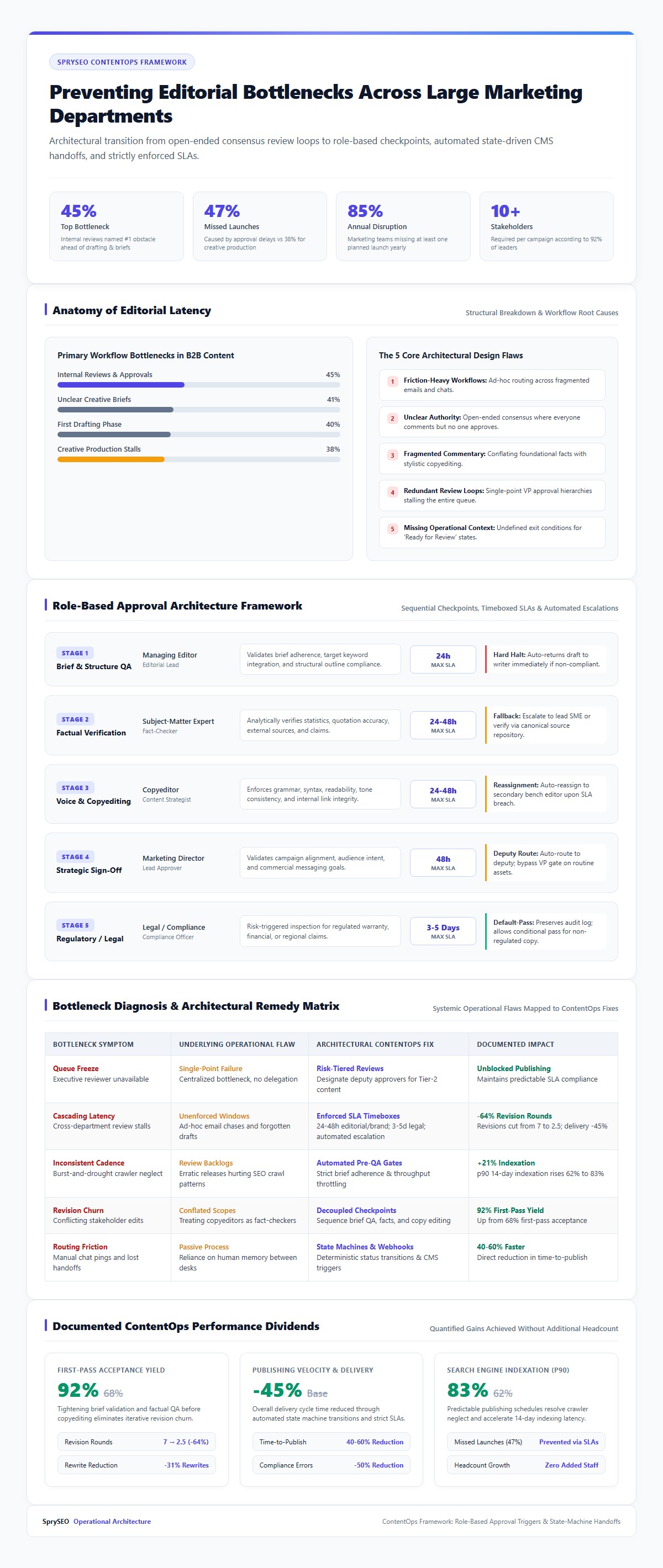
Role-Based Approval Architecture Framework
| Production Stage | Responsible Stakeholder | Review Scope / Trigger Criteria | Maximum Allowable SLA | Fallback / Escalation Action |
|---|---|---|---|---|
| Stage 1: Brief & Structure QA | Managing Editor / Editorial Lead | Brief adherence, keyword targeting, structural requirements | 24 Hours | Hard halt; auto-returns to writer if non-compliant |
| Stage 2: Factual Verification | Subject-Matter Expert / Fact-Checker | Statistical claims, quotations, data sources, technical accuracy | 24-48 Hours | Escalate to lead SME or verify via canonical source repository |
| Stage 3: Editorial & Voice Compliance | Copyeditor / Content Strategist | Grammar, syntax, brand tone, readability, link integrity | 24-48 Hours | Reassign to secondary bench editor via automated trigger |
| Stage 4: Strategic & Brand Sign-Off | Marketing Director / Lead Approver | Campaign alignment, messaging, commercial intent | 48 Hours | Route to deputy approver; bypass executive gate on routine assets |
| Stage 5: Regulatory & Legal Review | Legal / Compliance Officer | Risk-triggered review for regulated claims and regional terms | 3-5 Business Days | Automated alert preserving audit log; conditional pass for non-regulated copy |
Centralized Governance vs. Regional and Departmental Agility
The final architectural tension is organizational: how much control to centralize without creating a shared choke point.
Resolving Cross-Departmental Deadlocks with Product and Legal
The deadlock most likely to stall a pipeline is the collision between brand governance and subject-matter authority. Risk-triggered routing resolves it by sending only genuinely regulated content—warranties, compliance-sensitive claims, regional legal terms—to legal review, with an automated alert to the project owner that preserves an audit log. Everything else proceeds without legal in the loop. This prevents a shared editorial or legal service bureau from becoming a systemic delivery bottleneck across business units.
Preventing Subjective Style Debates from Derailing Scheduled Deadlines
Consensus-driven editorial review is the single greatest destroyer of publishing velocity in large marketing departments; every piece of content must have exactly one ultimate gatekeeper per stage. Subjective stylistic preferences must never acquire the same blocking power as factual or regulatory verification. When copyediting is collapsed from multiple perfectionist rounds into a single accountable pass, velocity recovers without measurable quality loss—because the critical gates (brief adherence and fact accuracy) have already run upstream.
Measuring Review Velocity and Continuous Workflow Optimization
An optimized workflow is auditable. Without quantitative latency tracking, teams cannot distinguish a genuine fix from a temporary reprieve.
Core Metrics: First-Pass Yield, Review Cycle Latency, and Idle Time
The decisive ContentOps indicator is first-pass acceptance yield. In documented cases, tightening briefs and enforcing review gates lifted first-pass acceptance from 68% to 92%. Review cycle latency—the elapsed time an asset spends in each stage—exposes where queues freeze, while contributor idle time reveals reviewers who are over-tasked or mis-assigned. Editorial workflow tooling that tracks time-to-publish and revision counts makes these metrics observable rather than anecdotal.

Conducting Post-Mortem Audits to Identify Friction Points
The quantified payoff of disciplined ContentOps is substantial: organizations that replace ad-hoc processes with documented workflows and automation report a 40-60% reduction in time-to-publish and a 50% decrease in content errors and compliance issues—without adding headcount. Routine post-mortem audits that map each bottleneck symptom to its underlying operational flaw and architectural fix turn the Diagnosis Matrix from a one-time blueprint into a continuous improvement loop.
The throughline is consistent. Editorial bottlenecks are not caused by lazy reviewers or slow writers; they are caused by workflow architecture that depends on human memory, open-ended consensus, and unconstrained review windows. Replace that architecture with role-delimited triggers, state-driven handoffs, and enforced SLAs, and both velocity and quality improve simultaneously.
About the Author
This article was produced by the SprySEO editorial team. SprySEO is an SEO and GEO content automation platform that connects website analysis, topic planning, AI article generation, SEO and GEO checks, and scheduled publishing. Our team works with content operations managers, SEO specialists, and marketing teams to build structured publishing workflows that scale organic search visibility and AI answer-engine citations across multiple sites and languages.
Disclaimer
This article is provided for general informational purposes only and does not constitute legal, compliance, or professional operational advice. Statistics and benchmarks cited reflect third-party research available at the time of writing and may vary by organization, industry, and regulatory context. Review SLAs, escalation protocols, and governance structures—particularly those involving legal or compliance sign-off—should be validated against your organization's specific requirements before implementation.
Frequently asked questions