Unlocking Long-Tail Traffic by Automating Niche Content Expansion
Systematically target specialized user intents by producing focused, high-relevance articles mapped directly to long-tail search queries in your industry.

Automating niche content expansion replaces fragmented keyword research with an engineered pipeline: one that clusters long-tail search intent, validates Information Gain, and programmatically publishes entity-grounded assets. Instead of competing on saturated head terms, growth teams deploy automated quality gates to scale hyper-relevant, low-competition pages that collectively capture high-converting search volume without triggering duplication penalties.
Key Takeaways
- Specific queries convert far better. Queries of three or more words convert 6.1x better than one- and two-word queries, and long-tail searches account for over 91% of all web searches.
- The demand is invisible to manual research. 93% of queries in Ahrefs' US database get fewer than 10 searches monthly, and fewer than 18,000 keywords exceed 100,000 monthly searches, making clustered automation essential.
- Quality gates are non-negotiable. Google's scaled content abuse policy targets pages built to manipulate rankings regardless of how they are produced; Information Gain validation prevents thin-content suppression.
- Cannibalization is deterministically detectable. Embedding pages and flagging cosine similarity scores above 0.9 isolates sibling pages competing for the same intent.
- Dual retrieval requires structure. Answer-first openings in the first 40 words plus 150-word syntactic blocks and scoped data tables serve both SERPs and AI answer engines.
The Economics of Niche Expansion: Why the Tail Outperforms the Head
The strategic case for niche expansion rests on a persistent market asymmetry: granular queries yield conversion rates disproportionate to their search volume. Treating long-tail discovery as an occasional spreadsheet exercise ignores the compounding economics behind structured, distributed organic reach.
The Conversion Premium of Hyper-Specific Search Intent
Search queries of three words or more convert 6.1 times better than one- and two-word queries. When a searcher enters an extended phrase, they are articulating an active requirement rather than initiating casual discovery. This specificity bypasses the noise and volatility of broad head terms. Every qualifying parameter—a workflow constraint, a software stack, or an operational edge case—removes ambiguity and signals immediate commercial or operational intent, transforming negligible search volume into reliable, high-yield pipeline.

The Diminishing Returns and Surging Acquisition Costs of Head Keywords
Head terms are structurally scarce and increasingly uneconomical. In Ahrefs' US keyword database, fewer than 18,000 keywords receive more than 100,000 monthly searches, contrasted against a long-tail landscape of billions of low-volume queries. Concentrating acquisition spend on this narrow band forces teams into zero-sum battles against entrenched, high-authority domains. Prioritizing head terms while neglecting structured long-tail expansion burns operational capacity on contested SERPs with rapidly decaying marginal returns.
Cumulative Organic Footprints: Aggregating Fragmented Search Demand
The commercial leverage of the long tail exists at the aggregate level. With 93% of queries in Ahrefs' US database logging under 10 searches monthly and over 95% of conversational long-tail phrases registering zero measurable volume in standard tools, manual authoring cannot be justified on an individual URL basis. Yet when deployed systematically, hundreds or thousands of hyper-targeted pages compound into substantial, highly qualified traffic. Fragmentation creates the opportunity, and automation provides the delivery mechanism.
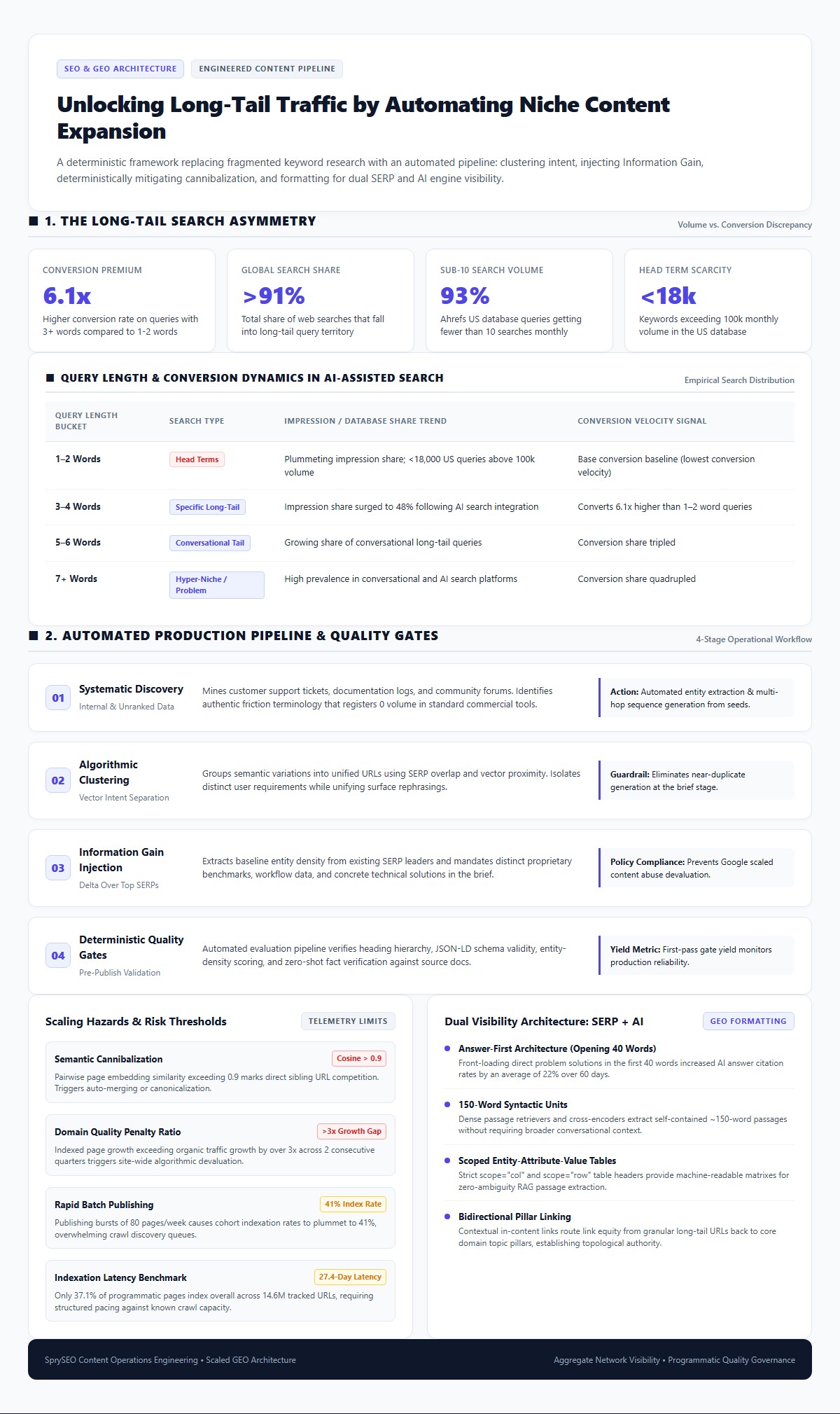
The rise of generative answer engines has accelerated this dynamic. Following AI search integration, Google Ads query data showed 3-4 word queries rising to a 48% impression share, while conversion shares tripled for 5-6 word queries and quadrupled for queries spanning 7 or more words.
| Query Length Bucket | Impression / Database Share Trend | Conversion Impact / Velocity Signal | Primary Sources |
|---|---|---|---|
| 1–2 Words (Head Terms) | Plummeting impression share; under 18,000 US queries above 100k volume | Base conversion baseline (lowest conversion velocity) | S62, S65 |
| 3–4 Words (Specific Long-Tail) | Impression share surged to 48% | Converts 6.1x higher than 1-2 word queries | S62, S64 |
| 5–6 Words (Conversational Tail) | Growing share of conversational long-tail queries | Conversion share tripled | S62 |
| 7+ Words (Hyper-Niche / Problem Queries) | High prevalence in conversational and AI search | Conversion share quadrupled | S62 |
Systematic Discovery: Deconstructing Domain Topics into Niche Clusters
Capturing fragmented search demand requires a discovery architecture that systematically unpacks primary topic pillars into hundreds of high-intent sub-queries that manual audits consistently overlook.
Mining Support Repositories, Product Documentation, and Community Queries
The most actionable long-tail intent lives inside first-party friction logs. Customer support tickets, engineering documentation, and community threads expose complex multi-hop queries and production edge cases described in the user's exact operational vocabulary. Because most conversational phrases register zero volume in conventional keyword databases, mining internal repositories surfaces authentic, unaddressed demand long before commercial search tools register it.
Automated Entity Extraction and Multi-Hop Question Expansion
Raw query inputs become actionable content roadmaps through automated entity extraction. Parsing top-ranking search results to map entity co-occurrence patterns reveals where competitive coverage falls short. Multi-hop expansion routines then trace the logical sequence of follow-up questions tied to each seed entity, transforming a single product feature into an interconnected network of problem-resolution pages.
Algorithmic Clustering: Grouping Semantic Variations to Isolate Unique Intents
Not every phrasing variation warrants a dedicated URL. Combining SERP overlap metrics with vector clustering groups closely related search strings into unified targets, allowing one comprehensive page to rank for numerous surface variations while cleanly siloing distinct search intents. Vector databases evaluate semantic proximity automatically, mapping foundational attributes rather than matching literal keywords. This algorithmic separation prevents internal competition and eliminates near-duplicate generation at the source.

Engineering the Automated Niche Production Pipeline
Building an automated production engine requires translating clustered intent into structured briefs and enforcing programmatic quality checks before assets reach production environments.
From Clustered Queries to Machine-Executable Production Briefs
Every query cluster must compile into a machine-executable brief. An effective Generative Engine Optimization (GEO) brief establishes target entities, isolates citation-worthy technical assertions, and specifies machine-extractable content formats such as definitions, structured comparisons, and procedural workflows. Semantic entity clustering within the brief establishes the required topical boundary, directing generation models to deliver analytical depth rather than generic prose.
Injecting Proprietary Context to Secure High Information Gain Scores
Information Gain separates durable programmatic assets from commoditized template churn. Search and retrieval systems evaluate this delta by extracting entities from top-ranking URLs, charting baseline entity density, and comparing those baselines against incoming drafts. Pages that merely echo prevailing ranking content add zero information value. Integrating proprietary benchmark data, documented workflows, and concrete technical solutions provides the distinct informational delta modern search and generative engines demand.
Automated Quality Gates: Heading Validation, Schema Staging, and Fact Grounding
Reliable scale requires deterministic gatekeeping. Every programmatic asset must pass automated validation stages prior to indexing: strict heading hierarchy verification, JSON-LD schema validation, entity-density scoring, and zero-shot fact verification against authorized source documentation. These automated checkpoints convert unrefined query inputs into compliant search assets, delivering the auditability and predictable yield required to run scaled ContentOps.

Navigating Scaling Hazards: Cannibalization, Thin Content, and Crawl Budget
Rapid programmatic deployment presents operational vulnerabilities. Without rigorous controls, three structural hazards—thin content flags, semantic cannibalization, and crawl budget depletion—can stall domain-wide organic performance.
The Strict Boundaries Between Programmatic Value and Template Bloat
Google's spam policies define scaled content abuse as generating high-volume pages designed primarily to manipulate rankings without delivering substantive value, regardless of whether generation is manual, algorithmic, or hybrid. The regulatory trigger is thin informational value, not the production mechanism. In one documented programmatic publishing study, thin automated pages triggered a domain-level quality penalty; systematically pruning 13,000 low-value URLs restored the domain's organic footprint. Deploying templated layouts without differentiated information gain invites platform-wide algorithmic suppression.
Deterministic Cannibalization Detection Across Sibling URLs
Internal intent overlap can be surfaced deterministically through dense vector representations. Generating embeddings for all page assets and measuring pairwise cosine similarity provides clear visibility into cross-page overlap: scores exceeding 0.9 indicate direct intent cannibalization. Pairing embedding similarity with intent-classification classifiers enables content teams to merge, canonicalize, or redirect conflicting URLs before sibling assets split link equity and dilute ranking signals.
Managing Indexing Velocity and Crawl Budgets Across Rapid Topic Deployments
Indexing throughput represents an unavoidable operational bottleneck. Across an analysis of 14.6 million programmatic SEO pages, only 37.1% were successfully indexed, averaging 27.4 days to reach index status. Deploying bursts of 80 pages within a single week dropped cohort indexing rates to 41%, demonstrating that rapid batching frequently overwhelms discovery pipelines and leaves assets stranded in crawl queues. Google defines crawl budget as the aggregate volume of URLs it can and intends to crawl, which becomes critical for sites with over 1 million pages refreshing weekly, 10,000 updating daily, or high counts of "Discovered – currently not indexed" statuses. Deployments must be scheduled against known crawl and indexing capacity rather than unthrottled publishing output.
| Metric / Hazard Parameter | Empirical Benchmark / Observation | Operational Risk / Algorithmic Trigger | Source IDs |
|---|---|---|---|
| Overall Programmatic Indexation Rate | 37.1% indexed across 14.6M tracked pages | Unindexed pages linger with 27.4-day average latency | S59 |
| Rapid Batch Publishing Impact | Batch rate drops to 41% when publishing 80 pages/week | Exhaustion of indexing throughput and crawl queues | S59 |
| Domain-Level Quality Penalty Ratio | Indexed page growth exceeding traffic growth by >3x over 2 quarters | Triggers scaled content abuse / site-wide devaluation | S63 |
| Semantic Cannibalization Threshold | Cosine similarity > 0.9 between page embeddings | Internal intent competition and keyword cannibalization | S73 |
A programmatic program is highly likely to face algorithmic intervention when its indexed page count outpaces organic traffic growth by more than 3x across two consecutive quarters. Monitoring this ratio provides ContentOps teams with a critical early warning before systemic penalties take effect.
Formatting Niche Content for Dual Visibility: SERPs and AI Answers
Niche architectures must serve two distinct discovery layers simultaneously: document-level SERP indexers and passage-level generative engines. While traditional search ranks entire web documents, AI search platforms locate, score, and synthesize modular passages into consolidated answer cards.
The Answer-First Framework for Long-Tail Problem Resolution
Dense passage retrievers and cross-encoder rerankers discard content obscured by conversational introductions. Structure dictates extraction success. Packaging solutions within self-contained syntactic units of approximately 150 words—anchored by an explicit answer within the first 40 words—significantly improves retrieval probability. In production audits, front-loading the core answer within the opening 40 words increased AI search citation rates by an average of 22% over 60 days. Structuring copy to deliver immediate answers serves both the end user and machine extraction models.

Embedding Entity-Attribute-Value Tables for RAG Passage Extraction
Structured tables provide ideal ingestion targets for retrieval pipelines, provided their semantic markup is explicit. When dense retrieval parsers ingest HTML tables lacking clear scope attributes on header tags, the engine must infer coordinate relationships, creating data ambiguity. Correctly scoped header markup ensures tables function as distinct entity-attribute-value stores that RAG architectures can parse and cite without entity attribution errors.
Contextual Internal Linking: Routing Long-Tail Equity Back to Topic Pillars
Isolated long-tail URLs lack the baseline equity needed to maintain rankings over time. In-content contextual internal links route equity from granular problem-solving assets back into parent topic hubs and core pillars. This bidirectional link topology clarifies structural relationships for search crawlers while demonstrating authoritative depth across the broader domain.
Measuring Collective Performance: Modern Long-Tail Content Ops KPIs
Evaluating long-tail expansion through traditional, single-keyword vanity tracking distorts performance. The operational unit of measurement must reflect aggregate network performance.
Tracking Aggregate Traffic Volume vs. Individual URL Metrics
Because single long-tail URLs capture limited search volume, page-by-page traffic monitoring fails to reflect program health. ContentOps leaders evaluate cohorts by cumulative organic sessions, blended conversion yield, and aggregate SERP footprint across entire topic clusters. A page delivering single-digit monthly visits remains an effective asset when it functions as an automated, low-maintenance node within a compounding network.
Monitoring First-Pass Gate Yield, Indexation Latency, and Downstream Conversions
Scaling niche content successfully requires managing production via operational telemetry. Tracking indexing velocity as a core KPI shifts focus toward technical throughput: measuring the elapsed time between publication and indexing, and tuning deployment batching to compress that window. Critical operational indicators include first-pass quality-gate yield, the indexed-page-to-traffic ratio as a penalty baseline, and direct multi-touch conversions generated across the long-tail inventory. Managing these metrics enables growth teams to scale coverage responsibly—safeguarding crawl efficiency while capturing the profitable intent that head-term strategies miss.
About the Author
This article was produced by the SprySEO editorial team. SprySEO is an SEO and GEO content automation platform that connects website analysis, topic planning, AI article generation, SEO and GEO checks, and scheduled publishing. The team works with content operations managers, SEO specialists, and growth marketers to help brands build structured, scalable publishing workflows that earn visibility in both traditional search engines and AI answer engines.
Disclaimer
This content is provided for informational purposes only and reflects research and benchmarks available at the time of writing. Search engine algorithms, indexing behavior, and generative engine retrieval systems change frequently, and results vary by site, industry, and implementation. The statistics and thresholds cited are drawn from third-party studies and should be validated against your own data before making strategic decisions. Nothing here guarantees specific rankings, traffic, or indexation outcomes.
Frequently asked questions