Optimizing B2B SaaS Content for Generative Search Decision Cycles
Win software buyers who use AI chat assistants for vendor comparisons with structured evaluative content and transparent technical documentation.

Optimizing B2B SaaS content for generative search decision cycles requires replacing vague marketing copy with structured evaluative frameworks, un-gated technical documentation, and transparent feature matrices. Because AI search assistants build vendor shortlists by extracting verifiable facts and unambiguous comparative data via retrieval-augmented generation (RAG), brands that provide machine-readable, balanced, and technically detailed information dominate generative recommendations.
The buying motion has quietly inverted. In 2026, 94% of B2B buyers use AI somewhere in the purchasing process, and 95% of deals originate from a Day One shortlist formed before any vendor contact. When software lacks representation in the machine-readable layer queried by AI assistants, sales teams end up competing for seats on lists assembled without their knowledge.
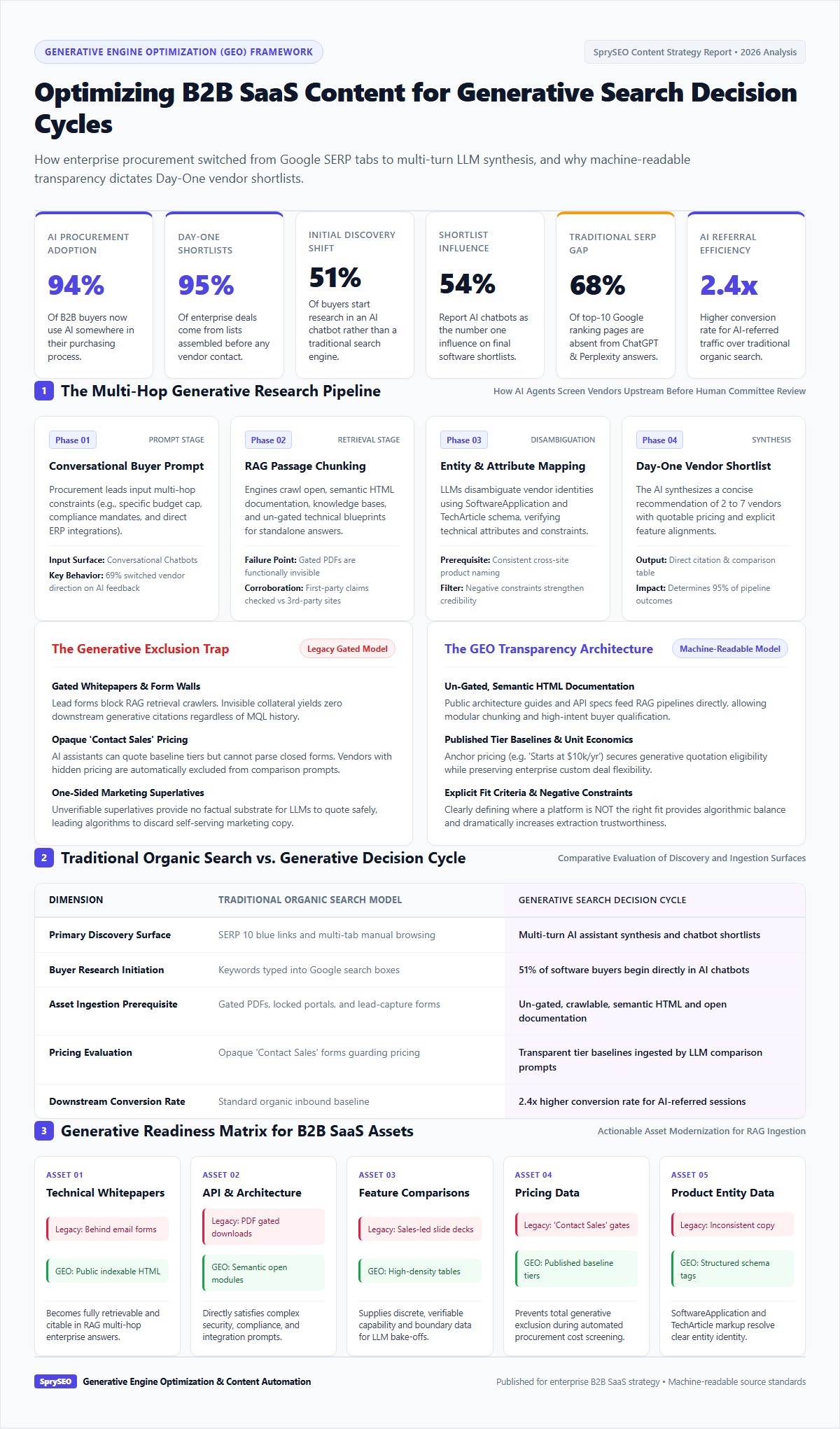
Key Takeaways
- 94% of B2B buyers now use AI during the purchasing process, and 95% of deals come from a Day One shortlist established before vendor contact.
- 51% of software buyers start research inside an AI chatbot rather than a search engine, and 69% switched vendor direction based on AI guidance.
- Gated PDFs and forms are invisible to RAG retrieval engines like ChatGPT, Perplexity, and Google AI Overviews, so your best collateral may not exist in AI answers.
- Hidden pricing causes generative exclusion: AI can quote a specific baseline but cannot quote 'Contact Sales,' so opaque vendors drop out of comparison prompts.
- AI-referred traffic converts at 2.4x the rate of traditional organic search, making generative visibility a pipeline priority, not a vanity metric.
- Schema markup acts as machine-readable vocabulary for LLMs, so SoftwareApplication and TechArticle structured data improve entity extraction and citation eligibility.
The Shift to Conversational Procurement in B2B SaaS
From SERP Multi-Tab Browsing to Multi-Turn AI Synthesis
The classic B2B research journey meant typing keywords into Google, opening a dozen tabs, and manually reconciling conflicting claims. Conversational AI search has collapsed that workflow. Buyers now ask complex, nuanced questions and receive direct, synthesized answers rather than scanning a list of links. A buyer can request a specific comparison and get a detailed evaluation summary in a single turn.

This fundamentally alters the evaluation surface. Instead of a landing page competing for attention against nine blue links, individual facts compete for extraction inside a single synthesized answer. Content that cannot be parsed and cited is simply absent from the conversation.
How Software Buying Committees Delegate Vendor Research to LLMs
The behavioral data is unambiguous. G2 survey data shows 51% of B2B software buyers now begin research inside an AI chatbot rather than a traditional search engine, and AI chatbots are the number one influence on shortlists according to 54% of buyers. Critically, 69% of buyers changed vendor direction based on what the chatbot told them.
That delegation changes the audience product marketers are actually addressing. Shortlists are increasingly assembled upstream by autonomous agents querying vendor sites in parallel. Bottom-of-funnel content now speaks to machines that read, compare, and filter before human committee members ever view a brand asset.
The Anatomy of an AI-Driven Software Comparison Prompt
When a procurement lead asks an assistant to compare two platforms on price, integrations, and compliance, the engine executes a multi-hop evaluation. It pulls from review sites, comparison articles, community threads, and analyst mentions, then assembles a concise shortlist of typically two to seven vendors. Because the output is compact by design, marginal or ambiguous sources get discarded rather than relegated to page two.
How Generative Engines Evaluate and Shortlist SaaS Vendors
Passage Extraction and Retrieval in Enterprise Software Queries
Generative engines rely on retrieval-augmented generation: they retrieve relevant passages from indexed, crawlable content and synthesize them into an answer. The structural consequence is straightforward: facts unavailable as indexable text cannot be retrieved or cited. A 2026 study of B2B SaaS queries found that 68% of top-10 Google ranking pages are absent from ChatGPT, Perplexity, and related AI search answers. High rankings in traditional search no longer guarantee inclusion in generative answers.
The Weight of Third-Party Consensus vs. First-Party Claims
Generative engines deliberately discount one-sided marketing hyperbole in favor of balanced comparative sources. Engines corroborate first-party claims against review sites, comparison articles, and community discussions. Self-serving superlatives perform poorly as extractable evidence because unverifiable boasts give models nothing safe to quote. Balanced, specific, and checkable statements survive the extraction filter.
Entity Disambiguation and Attribute Verification Across Technical Datasets
Before an engine can compare a vendor, it must identify that vendor as a distinct entity and map its core attributes. Inconsistent product naming, scattered technical specifications, and contradictory feature descriptions introduce friction during entity disambiguation. Publishing clean, consistent, machine-readable attribute data ensures a product is straightforward to identify, verify, and recommend.
Architecting Structured Evaluative Content for LLM Ingestion
Building High-Density Feature and Capability Matrices
High-density comparison matrices are among the most reliably extracted assets for generative engines. A clean table mapping capabilities, integrations, and constraints gives models discrete, verifiable data points ready to drop into comparative responses. Comparison pages, alternatives guides, technical documentation, and pricing or ROI pages serve as the primary answer-engine surfaces.

Objective Competitor Alternatives: Embracing Negative Constraints and Fit Criteria
Publishing explicit fit criteria—including clear explanations of when a platform is not the right choice—materially strengthens generative trust. Because engines prioritize balanced coverage, content that defines negative constraints and ideal-customer boundaries carries more algorithmic credibility than uniformly glowing claims. Defining architectural limits is no longer just good copywriting; it directly impacts extraction eligibility.
Structuring Definitive Answers for Deep Evaluation Queries
Deep evaluation prompts frequently chain multiple constraints, pairing compliance frameworks with specific integration requirements. Content must answer these multi-hop questions directly and unambiguously, with each passage written to stand alone during retrieval. State the answer upfront, then substantiate it with verifiable specifics.
Transparent Technical Documentation as a High-Intent Conversion Driver
Un-gating Architectural Blueprints, Security Standards, and API Docs
Public, un-gated technical documentation feeds RAG retrieval pipelines directly. Gated content, lead capture forms, and locked PDFs prevent crawler access and remain functionally invisible to AI retrieval engines like ChatGPT, Perplexity, and Google AI Overviews. The highest-quality assets in most enterprise libraries—in-depth architecture guides and API references—are frequently hidden behind forms, rendering them non-existent to AI search.

The commercial payoff for opening these resources is measurable: AI-referred buyer traffic converts at 2.4 times the rate of traditional organic search. Buyers arriving via synthesized comparisons have already vetted their technical requirements.
Formatting Technical Passages for Seamless RAG Chunking
Un-gating documentation is only the initial step; the text itself must be easily chunkable. Publishing technical content as open, semantic HTML with clear headings, pure tables, and modular sections allows retrieval systems to isolate relevant passages cleanly. Complex PDFs and image-based specification sheets resist extraction even when technically crawlable.
The Strategic Cost of Gated Collateral in Generative Indexing
This shift surfaces a sharp operational friction. B2B teams frequently weigh gating whitepapers for immediate MQL capture against un-gating them so RAG agents can index and cite their content. The evidence points in one direction: during preliminary AI screening, collateral that cannot be crawled cannot be cited, and invisible collateral creates no pipeline regardless of past email-capture figures. Gated PDFs now act as a visibility bottleneck.
The Transparency Dilemma: Pricing and Operational Friction
Why Obscured Pricing Causes Generative Exclusion in Vendor Bake-Offs
Hiding pricing behind 'Contact Sales' barriers suppresses vendor inclusion during comparative prompts. When a procurement manager asks an assistant to compare platform costs, the vendor offering quotable pricing wins the citation. AI models readily cite baselines like 'Enterprise plans start at $10,000/year' but cannot quote an opaque sales form. The 'Contact Sales' gate that once projected enterprise exclusivity now eliminates brands from the discovery set.
Publishing Tier Architectures and Unit Economics Without Breaching Enterprise Flexibility
A related tension exists between pricing transparency and enterprise deal customization. Withholding pricing to protect negotiation flexibility leads AI assistants to favor competitors with quotable structures. The solution lies in publishing clear tier architectures and baseline anchor figures to secure inclusion, while reserving custom scoping for enterprise sales discussions. The objective is giving engines enough context to include the product in comparisons, not exposing bespoke deal terms.
Technical Foundation: Schema, Semantic Markup, and Data Hygiene
Deploying SoftwareApplication and TechArticle Structured Data
Structured schema markup provides a machine-readable vocabulary for LLMs and AI answer engines, improving entity extraction and citation visibility. For B2B SaaS platforms, deploying SoftwareApplication, Product, and TechArticle structured data helps engines map product attributes accurately and classify content types during evaluation queries.

Standardizing Entity Naming Conventions Across Product Lines
Schema delivers value only when underlying entities remain consistent. Standardizing product names, module titles, and capability descriptions across the entire web footprint ensures that when an engine encounters a brand across documentation, pricing tiers, and comparison pieces, it resolves those references to a single, unambiguous entity.
Maintaining Ingestion Cleanliness and Machine-Readable Text Layers
AI platforms need frictionless access to product pages, technical documentation, and core resources. Clean machine-readable text layers, intuitive information architecture, and the absence of crawler impediments form the essential baseline. Without this technical hygiene, well-written product content never reaches the retrieval index.
Measuring Generative Consideration and Pipeline Attribution
Tracking Vendor Inclusion Share and Prompt Citation Frequency
Measuring generative engine optimization (GEO) requires tracking model citation frequency and assistant share of voice across the platforms buyers rely on. The core metrics have shifted: because a top-10 Google ranking no longer ensures inclusion in generative answers, marketing teams must evaluate citation rates and model recommendation frequency across primary buyer-intent prompts rather than monitoring organic traffic alone.
Connecting AI Assistant Discoveries to Multi-Touch Pipeline Attribution
Connecting AI search visibility to revenue requires distinct UTM parameters on AI referral links, dedicated tracking in analytics platforms, and pipeline attribution inside the CRM. Tracking the first AI-referred lead through to a qualified pipeline opportunity provides the definitive proof point for sustained GEO investment.
Traditional B2B SaaS Inbound vs. Generative AI Decision Cycle
| Dimension | Traditional Organic Search Model | Generative Search Decision Cycle |
|---|---|---|
| Primary Discovery Surface | SERP 10 blue links and multi-tab browsing | Multi-turn AI assistant synthesis and chatbot shortlists |
| Buyer Research Initiation | Keywords typed into Google search boxes | 51% of buyers start directly in conversational AI engines |
| Asset Visibility Prerequisite | Gated PDFs and lead-capture landing forms | Un-gated, crawlable, semantic HTML and open documentation |
| Pricing Evaluation | Opaque 'Contact Sales' forms for lead gating | Transparent tier baselines ingested by LLM comparison prompts |
| Traffic Conversion Efficiency | Standard organic inbound baseline | 2.4x higher conversion rate for AI-referred sessions |
Generative Readiness Matrix for B2B SaaS Assets
| Asset Type | Traditional Gating Practice | Recommended GEO Architecture | LLM Ingestion Benefit |
|---|---|---|---|
| Technical whitepapers | Behind email-capture forms | Public, indexable HTML pages | Becomes retrievable and citable in RAG answers |
| API and architecture docs | PDF downloads or gated portals | Open, semantically structured documentation | Supports multi-hop integration and compliance queries |
| Feature comparisons | Sales-led decks | High-density public comparison matrices | Supplies discrete, extractable attribute data |
| Pricing information | 'Contact Sales' only | Published tier baselines plus anchor | Earns inclusion in comparative pricing prompts |
| Product entity data | Inconsistent across pages | SoftwareApplication and TechArticle schema | Improves entity disambiguation and attribute mapping |
The underlying reality is consistent across formats: collateral that B2B SaaS teams previously guarded behind forms represents the exact data generative engines require in the open. Transforming bottom-of-funnel collateral into canonical, machine-readable source material is now essential for retaining visibility throughout conversational evaluations.
About the Author
This guide was produced by the editorial team at SprySEO, an SEO and GEO content automation platform that connects website analysis, topic planning, AI article generation, SEO and GEO checks, and scheduled publishing. The team focuses on helping brands earn visibility in both search engines and AI answer engines, drawing on hands-on experience building structured, machine-readable content workflows for multi-site and multilingual publishing programs.
Disclaimer
This article is provided for general informational and educational purposes only and does not constitute professional marketing, legal, or procurement advice. Generative search behaviors, AI engine capabilities, and the statistics cited here reflect sources available at the time of writing and may change. Readers should validate strategies against their own data, audience, and compliance requirements before implementation. Results such as conversion and citation rates vary by organization and are not guaranteed.
Frequently asked questions