Automating Editorial Calendars: From Backlog Prioritization to Delivery
Connect ideation, draft creation, quality checks, and scheduled publishing into a unified pipeline that keeps content marketing programs on schedule.

Automating editorial calendars involves replacing fragmented spreadsheets with an event-driven content pipeline that systematically scores backlogs, enforces automated QA gates during drafting, and dispatches approved content to CMS endpoints on schedule. By standardizing status transitions and connecting topic scoring directly to webhook publishing, teams eliminate manual coordination bottlenecks, maintain a strict organic publishing cadence, and increase content velocity without sacrificing editorial standards.
Key Takeaways
- An editorial calendar is the operational hub connecting story planning, task ownership, and publishing schedules across print, digital, newsletters, and social channels.
- Spreadsheet-based tracking breaks down in enterprise environments, pushing teams toward workflow automation platforms.
- Backlog items should be ranked with a quantitative model weighting citation opportunity (30%), business value (30%), search volume (20%), and competitive gap (20%), with scores of 7+ entering production first.
- Automated pipelines depend on human review gates where editors evaluate output before it advances downstream.
- Headless CMS webhooks, event triggers, and scheduled API functions handle dispatch, with retry queues preserving continuity when jobs fail.
- Agencies automating calendar operations report 50%–60% reductions in coordination overhead, and structured GEO calendars earned 3.1x more citations per piece than reactive publishing.
The Breaking Point of Manual Editorial Calendars
An editorial calendar is not merely a schedule. It functions as the operational hub connecting story planning, task assignments and ownership, and publishing schedules across a range of channels including print, digital, newsletters, and social media. When that hub is built on a static document, the coordination logic lives in people's heads rather than in the system itself.
The Trap of Spreadsheet Management and Asynchronous Chaos
Traditional spreadsheet-based management works at small scale, but it breaks down in enterprise content environments. As volume grows, the friction of manually updating cells, chasing status, and reconciling versions drives teams toward dedicated workflow software and automation platforms. The underlying principle practitioners emphasize is decisive: mature content operations should automate complete workflows from backlog request to delivery, not simply schedule individual tasks. A calendar that documents dates without driving automated execution is an administrative burden rather than a productive system.

Backlog Bloat: Why Unprioritized Topic Pools Paralyze Teams
The second failure mode is backlog bloat. When topic ideas accumulate without a ranking mechanism, production capacity gets spent on whatever surfaces loudest in a brainstorm rather than on what delivers the most value. Prioritizing content based solely on subjective internal discussion guarantees wasted capacity. The backlog needs to be mathematically ranked against organic demand and topical authority needs so that the next item into production is always the next most valuable item.
The Compounding Cost of Sporadic Publishing Cadence on SEO and GEO
Inconsistent cadence carries a compounding cost. For generative engine optimization in particular, a structured content calendar that runs quarterly themes, a weekly cadence, and planned refresh cycles outperformed reactive publishing: one cohort earned 3.1x more citations per piece than teams publishing sporadically in early 2026. Cadence consistency is not a cosmetic nicety; it is a direct input into visibility across both search engines and AI answer engines.
Algorithmic Backlog Prioritization: Moving Beyond Subjective Guesswork
The cure for backlog bloat is a scoring model that converts strategy into a ranked queue. This is where editorial planning stops being opinion-driven and becomes repeatable.
Scoring Frameworks: Balancing Search Demand, GEO Citation Gain, and Commercial Intent
A practical prioritization model weights four dimensions and combines them into a single composite score. Citation opportunity and business value each carry the heaviest weight, reflecting a shift toward content that both earns generative engine citations and sits close to revenue. Topics reaching a composite score of 7 or higher are ingested into production first.
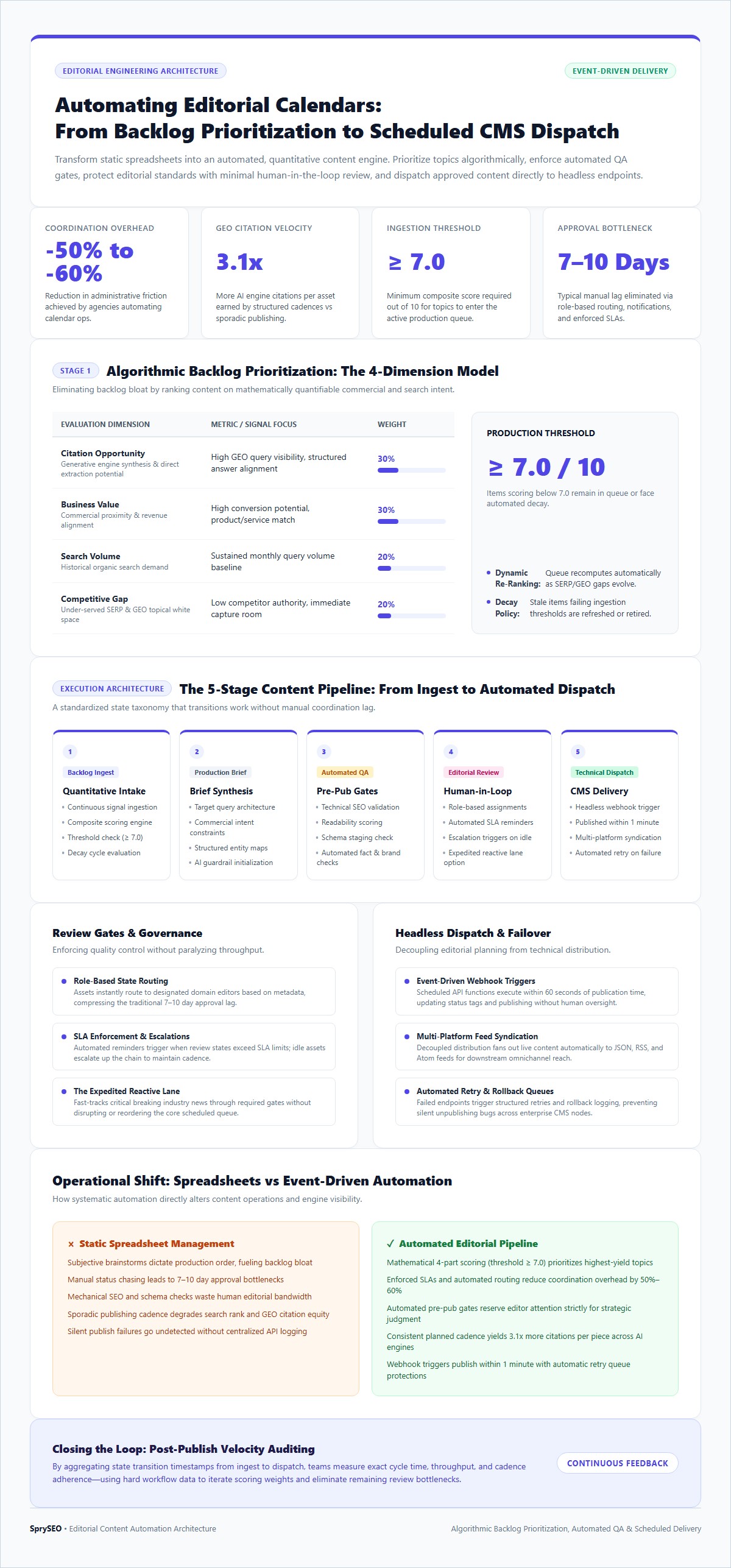
| Evaluation Dimension | Metric / Signal | Scoring Weight | Threshold for Production Ingestion |
|---|---|---|---|
| Citation Opportunity | Potential for generative engine synthesis and direct answer extraction | 30% | Part of composite score >= 7.0 |
| Business Value | Commercial conversion proximity, alignment with product/service revenue | 30% | Part of composite score >= 7.0 |
| Search Volume | Historical organic search demand | 20% | Part of composite score >= 7.0 |
| Competitive Gap | Under-served SERP/GEO topical territory | 20% | Part of composite score >= 7.0 |
Dynamic Queue Re-Ranking: Reacting to Algorithmic Shifts and Competitor Gaps
A score calculated once and frozen quickly goes stale. Because the competitive gap and citation dimensions depend on an evolving landscape, the queue should be re-ranked as new signals arrive. When a competitor leaves a topical territory under-served, items addressing that gap rise; when demand shifts, weights recompute. Automating this re-ranking keeps the top of the backlog aligned with current opportunity instead of last quarter's assumptions.

Pruning Stale Concepts: Implementing Backlog Decay Policies
Finally, backlogs need a decay policy. Items that never cross the ingestion threshold accumulate as noise and depress the apparent health of the pipeline. A disciplined policy either refreshes a stale concept with new signals or retires it, keeping the backlog a live production queue rather than an archive of good intentions.
Architecting an End-to-End Content Pipeline
Once the backlog is ranked, the next layer is the production pipeline that carries an item from concept to a dispatch-ready asset.
From Backlog Item to Structured Production Brief
The transition point is converting a scored backlog item into a structured production brief. This brief encodes the intent, target queries, and constraints so that downstream steps—whether human or AI-assisted—operate against the same specification. A clear brief is what allows later automation to run without re-litigating strategy at every stage.
Integrating AI Generation with Strict Brand and Fact-Checking Constraints
AI-assisted draft synthesis accelerates production, but it must run inside guardrails. The architectural pattern that works embeds quality into the pipeline rather than inspecting for it afterward: every automated step is paired with constraints, and output is evaluated before it advances. This is why automated pipelines embed review gates where human editors assess output before content moves downstream. Generation supplies speed; the constraints and gates supply trust.
Pre-Publication Automated Gates: SEO Checks, Readability, and Schema Staging
Before an asset is eligible for review, it should clear automated pre-publication gates. These validate technical SEO signals, readability, and structured data staging so that editors spend their attention on judgment rather than on mechanical checks a machine can perform. The result is that only assets meeting a baseline technical standard reach a human reviewer, protecting editorial time for the decisions that genuinely require it.
Designing Streamlined Editorial Review Gates
Review gates are where quality is enforced—and where pipelines most often stall. Designing them well is the difference between velocity and gridlock.
Status Taxonomies: Clear Transitions from Ingest to Ready-for-Dispatch
Every pipeline needs an unambiguous status taxonomy: a defined set of states an asset moves through from ingest to ready-for-dispatch. Clear transitions make the system legible—anyone can see where an asset sits and what happens next—and they are also the raw data later used to measure velocity. Without a taxonomy, automation has no reliable events to react to.
Role-Based Approval Workflows Without Operational Bottlenecks
Approval stages are frequently the primary bottleneck in a content pipeline. In manual setups, approvals can take 7 to 10 days when there are no buffered timelines or automated notifications. Role-based workflows that automatically route an asset to the right reviewer at the right transition, combined with notifications when content enters review, compress this lag. The architectural question is how much human sign-off is genuinely needed: enough to prevent brand and factual errors, but not so much that the queue paralyzes. That minimum viable human-in-the-loop review is what keeps automated velocity honest.
Enforcing SLAs: Automated Reminders and Editorial Escalation Paths
Gates hold only if service-level agreements are enforced. Automated reminders and escalation paths act as fallback triggers: when an asset sits in a state past its SLA, the system nudges the owner or escalates, preventing a single idle reviewer from stalling the entire queue. This governance layer is precisely what keeps multi-contributor review gates moving. The payoff is measurable—automating these operations is associated with 50% to 60% reductions in coordination overhead and shorter approval cycles.

Technical Delivery: Automating Scheduled CMS Dispatch
The final stage decouples planning from distribution so that an approved asset publishes itself when its scheduled moment arrives.
Decoupling Planning from Distribution via Webhooks and API Triggers
Headless CMS publishing workflows use webhooks, event triggers, and scheduled API functions to validate metadata, update document states, and dispatch approved content directly to distribution channels. In practice, within a minute of a scheduled time passing, an automated task can find the piece, update its status to published, and call the publish action through the CMS service. This event-driven design means the calendar is not just a record of intended dates—it is the mechanism that executes them.

Managing Multi-Platform Syndication and Feed Distribution (JSON/RSS/Atom)
Delivery rarely targets a single endpoint. Multi-endpoint distribution lets approved content fan out to several destinations, with feed formats such as JSON, RSS, and Atom supporting syndication to downstream consumers. Decoupling planning from distribution is what makes this tractable: the same approved asset can be dispatched to multiple channels without duplicating editorial effort.
Handling Failed Dispatches: Logging, Retries, and Rollback Procedures
Automated dispatch introduces a new failure surface. When dispatches or bulk execution jobs fail, mapping the source jobs into an automated retry queue lets the infrastructure re-queue the failed work and preserve pipeline continuity. Logging and retry logic turn a silent failure—an asset that simply never went live—into a recoverable event, which is essential once humans are no longer watching every publish.
Balancing Automation Velocity with Editorial Control
Automation is powerful precisely because it removes human steps, which is also its risk. The discipline is knowing where control must stay.
The Risk of Assembly-Line Content Quality Degradation
An over-automated pipeline can drift toward assembly-line output where speed outruns judgment. This is the structural argument for keeping review gates in the flow: humans evaluate output before it advances, especially for high-stakes assets. Quality embedded at each step, rather than bolted on at the end, is what prevents velocity from eroding standards.
Handling Time-Sensitive Reactive Stories Without Breaking Scheduled Queues
A real tension exists between rigid schedule adherence and opportunistic, time-sensitive stories. A highly automated queue risks feeling inflexible when an industry development demands an immediate response. The resolution is not to abandon the schedule but to design an expedited lane—a path that can push a reactive piece through the same gates quickly without reordering or breaking the planned queue. The automated cadence carries the predictable majority of work while a fast lane preserves agility for the exceptions.
Measuring Pipeline Velocity and Cadence Health
A pipeline you cannot measure is a pipeline you cannot improve. The status taxonomy you defined earlier becomes the instrumentation layer.
Core Operational Metrics: Cycle Time, Dispatch Throughput, and Cadence Adherence
Editorial velocity can be measured and audited by aggregating the state transition timestamps recorded across an asset's lifecycle. From those timestamps you derive cycle time—how long an item takes from backlog to publish—plus dispatch throughput and cadence adherence. These metrics expose where assets wait, which is almost always the approval stages identified earlier, and they quantify the coordination savings automation delivers.
Continuous Iteration: Conducting Post-Publish Workflow Audits
Metrics are most valuable when they feed a regular audit. Reviewing transition data after publishing reveals recurring bottlenecks, SLA breaches, and backlog decay patterns, which in turn inform adjustments to scoring weights, review routing, and dispatch logic. Treating the pipeline as a system under continuous iteration—rather than a tool configured once—is what sustains both velocity and quality as volume grows.
Author
This guide was produced by the SprySEO editorial team. SprySEO is an SEO and GEO content automation platform that connects website analysis, topic planning, AI article generation, SEO and GEO checks, and scheduled publishing, helping brands build repeatable content pipelines and gain visibility in search engines and AI answers.
Disclaimer
This article is provided for general informational purposes regarding content operations and editorial automation. Specific figures, scoring weights, and performance results cited here reflect the referenced sources and particular contexts; outcomes will vary by team, toolset, and market. Evaluate any framework against your own requirements and validate technical integrations before relying on them in production.
Frequently asked questions