Building Topical Depth to Enhance Generative Citation Probability
Establish authoritative domain coverage across complex subjects, signaling comprehensive expertise to both algorithmic search evaluators and generative engines.

Generative engines cite sources that demonstrate exhaustive topical depth because retrieval-augmented generation (RAG) algorithms prioritize semantically dense, authoritative passages that resolve multi-hop queries without ambiguity. Research reveals that AI citations are predominantly topic-local—with nearly 79% of cited domains appearing in just a single topic—meaning deep coverage of entity attributes, edge cases, and comparative contexts drives inclusion far more reliably than broad, shallow domain authority.
Key Takeaways
- RAG systems chunk documents into roughly 200–1,000 token passages, embed them, and retrieve top-K candidates—so your page competes at the passage level, not the document level.
- A study of six subject areas found that 78.8% of domains cited by AI answers appeared in exactly one topic, confirming that citations are won per question through topic-local depth.
- Information gain—how much genuinely new knowledge a page adds relative to candidate pages—acts as an active filter separating cited sources from ignored summaries.
- Citations decay fast: the median page loses half its citation share within 11 days of peaking, making freshness and iterative updates essential.
- Fragmented, overlapping subtopic clusters cause cannibalization that fractures AI citations across duplicate URLs; each URL should own one distinct intent.
The Evolution of Topical Authority in the Generative Search Era
Topical authority has shifted from a keyword-coverage concept to a structural measure of how completely and consistently a domain resolves a subject. In the generative era, authority is read as a content shape: interconnected entity clusters with stable, non-drifting definitions establish far greater authority than large volumes of disconnected articles.
From Keyword Density to Semantic Completeness
Topical depth refers to the thoroughness and richness of information within a content piece and across a topic cluster—what separates a shallow, surface-level article from a comprehensive hub. Modern evaluation rewards exhaustive coverage of subtopics, angles, definitions, and use cases rather than repeated keyword usage. The reliance on a few areas of profound expertise, rather than a wide-ranging but shallow collection of articles, positions an entity as an authority in the eyes of AI models.
How RAG Pipelines Chunk, Embed, and Rerank Document Passages
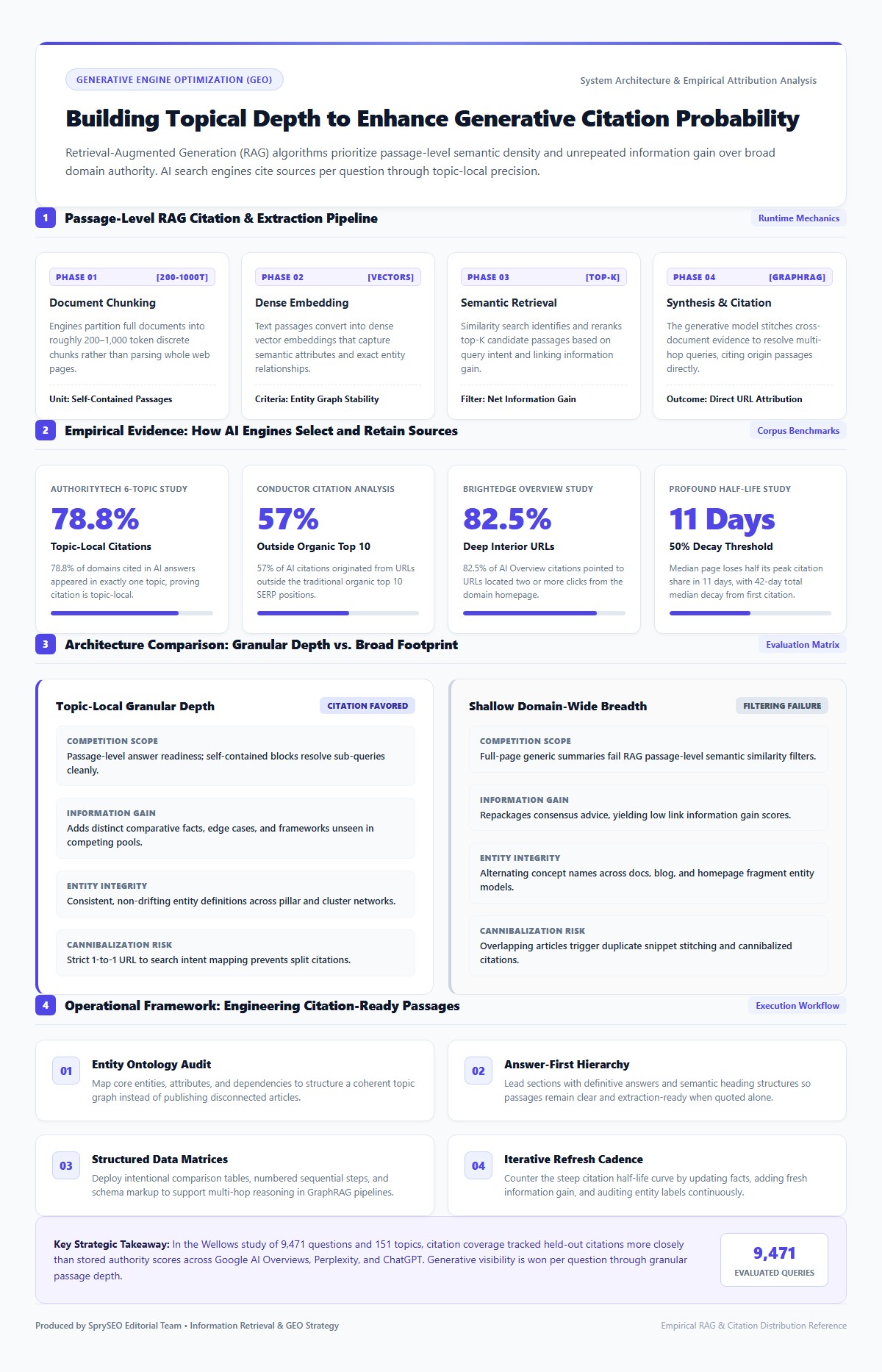
Understanding retrieval mechanics clarifies why depth matters. RAG systems typically split documents into chunks of 200 to 1,000 tokens, generate dense vector embeddings, execute semantic similarity search to retrieve the top-K most relevant chunks, rerank candidates, and construct prompts for the language model to synthesize and cite.
Crucially, the model does not read entire web pages—it sees chunks or passages. For each sub-query, the system processes retrieved content through chunking, embedding, and dense retrieval. Your page competes at the passage level, not the document level. This means every individual passage must stand on its own as a precise, self-contained answer to a specific question.

Topical Depth vs. Topical Breadth: Understanding the Citation Threshold
Topical depth and technical structure serve as two primary drivers of citations within AI search systems, requiring content that provides an exhaustive, rich well of knowledge across subtopics rather than shallow, multi-topic breadth.
Why Shallow Multi-Topic Coverage Fails Generative Filtering
When content spreads thin across many loosely related topics, individual passages rarely contain enough dense, specific information to win passage-level relevance scoring. In the editor's view, topical breadth without granular depth is actively harmful in the GEO era: it creates indexing bloat while failing passage-level RAG relevance filters. A page that offers generic advice loses to one that provides granular technical breakdowns, discrete passage answers, and exact entity definitions.
Topic-Local Authority: Why Niche Depth Trumps Domain-Wide Authority
The empirical case for depth is strong. A study across six measured subject areas revealed that 78.8% of domains cited by AI answers appeared in exactly one topic, indicating AI citations are topic-local rather than driven solely by domain-global authority. Similarly, a study across 9,471 questions and 151 topics found that citation coverage tracked held-out citations more closely than stored authority scores across Google AI Overviews, AI Mode, Perplexity, and ChatGPT.
This reframes strategy: domain authority may buy breadth in traditional search, but citation is won per question. Topical depth means having enough coverage to look like a genuine source rather than a one-page brochure.
Empirical AI Search Citation and Ranking Signals
| Study / Metric | Key Finding / Distribution |
|---|---|
| Wellows 9,471 Questions Study | Citation coverage tracked held-out citations more closely than authority scores on four of five engines (AI Overviews, AI Mode, Perplexity, ChatGPT) |
| AuthorityTech Topic-Local Distribution | 78.8% of domains cited in AI answers appeared in exactly one of six evaluated topics |
| Profound Citation Half-Life Analysis | Median page loses 50% of citation share within 11 days of peaking; median duration to lose 50% of peak share from first citation is 42 days |
| Conductor September 2026 Citation Analysis | 43% of AI citations originated from top 10 organic SERP URLs; 57% originated outside the organic top 10 |
| BrightEdge AI Overview Depth Analysis | 82.5% of AI Overview citations pointed to URLs located two or more clicks from the homepage |
Core Drivers of Generative Engine Source Attribution
Information Gain and Uniqueness in Dense Subject Clusters
Google holds a patent for "Contextual Estimation Of Link Information Gain" / "information gain score," which evaluates how much genuinely new or additional knowledge a document contributes relative to candidate pages already viewed or retrieved. Information gain is not just a theoretical patent concept—it operates as an active selection filter separating cited sources from ignored content by scoring whether a document contributes new, unrepeated knowledge to the candidate retrieval pool.
Practically, this means every passage should add a distinct fact, comparison, edge case, or framework not already present in competing documents. Repackaging consensus advice yields low information gain and poor citation odds.
Facilitating Multi-Hop Reasoning Through Connected Entity Context
Many AI answers require stitching evidence across concepts. Knowledge graphs combined with LLMs (GraphRAG) organize extracted knowledge into structured graphs, providing subgraph retrieval and path reasoning that improves cross-document bridging and multi-hop reasoning over flat RAG systems. By explicitly organizing knowledge into graphs, GraphRAG demonstrates superior controllability and reasoning power in complex query understanding compared to flat retrieval.
Content that explicitly names entities and clarifies how they relate—attributes, dependencies, and comparisons—makes it easier for these systems to traverse a reasoning path and cite your passages as connective evidence.

Structuring Data and Clear Claims for Direct Passage Extraction
Structuring content with self-contained standalone sections, intentional comparison tables, numbered sequential steps, schema markup, and consistent entity definitions enables direct extraction, summarization, and citation by AI answer engines. When a paragraph could be quoted on its own and remain clear, it is extraction-ready. Tables clarify comparisons and numbered steps preserve sequence—both formats map cleanly to how engines assemble answers.
Systematic Framework for Building Exhaustive Topical Depth
Auditing Current Coverage Against Domain Entity Ontologies
Start by translating your subject into an entity ontology—the core entities, attributes, and relationships that define the domain. Topical authority is a content shape rather than an arbitrary score: search engines and language models evaluate whether the entities on your pages connect into a coherent topic graph. A site with hundreds of disconnected articles on a nominal topic has weak authority, while a tightly connected cluster with definitions that do not drift across pages has strong authority.
Identifying Knowledge Gaps and Unanswered User Sub-Queries
Map the ontology against user questions and intent stages. Use question research and competitor outlines to ensure cluster completeness, then identify subtopics, definitions, comparisons, and troubleshooting angles that remain unanswered. Each gap represents a passage that could earn a citation for a specific sub-query currently resolved by a competitor.
Architecting Hierarchical Pillar and Cluster Networks Without Cannibalization
Organize coverage into a pillar-and-cluster hierarchy: a comprehensive pillar covering the core topic that links to detailed cluster articles, each covering exactly one search intent. This is where strategy meets risk. Keyword cannibalization across overlapping articles confuses AI models, leading to duplicate or split citations because language models stitch together matching snippets from competing pages on the same site.
To avoid this operational tension, assign each URL exactly one focus intent and ensure intents never overlap. Expanding fine-grained subtopics is valuable only when each page remains distinct; otherwise, the gains in coverage are offset by fractured citations across duplicate URLs.

Content Architecture Tactics to Maximize Extraction Likelihood
Answer-First Formatting and Semantic Heading Hierarchies
Lead each section with a direct, self-contained answer, then support it with evidence. Because each passage must remain clear when quoted alone, pause while writing and ask whether a paragraph would stand on its own if extracted. Semantic heading hierarchies help engines segment and match content to sub-queries.
Definitive Comparison Matrices and Structured Data Encodings
Comparison tables and schema markup encode relationships in formats engines extract cleanly. Intentional tables clarify trade-offs, while structured data and consistent entity definitions reinforce the connections that drive multi-hop reasoning and attribution.
Eliminating Conflicting Claims and Inconsistent Entity Labels
Entity inconsistency across a domain—such as alternating designations across the homepage, documentation, and blog—creates conflicting entity representations that degrade AI citation confidence. If the homepage, docs, and blog each name the same concept differently, you hand the model three entities instead of one. Standardize definitions and labels across every page to present a coherent, trustworthy source.
Measuring Generative Visibility and Managing Citation Decay
Tracking AI Engine Mentions and Attribution Prominence
Measure performance with several signals rather than a single number: citation frequency, citation share, source attribution, and sentiment across each platform. Note that citation does not depend on top organic position—analysis found 57% of AI citations originated outside the organic top 10, and 82.5% of AI Overview citations pointed to pages two or more clicks from the homepage. Deep interior passages can and do earn citations.
Iterative Content Refreshing to Counter the Citation Half-Life Curve
Citations are perishable. A study of AI citations found that the median page loses half its citation share within 11 days of peaking, and the median interval from first citation to losing half its peak share is 42 days. This half-life demands a continuous refresh cadence: update facts, add new information gain, and reinforce entity consistency to sustain inclusion rather than treating publication as a one-time event.

Resolving the Depth vs. Authority Debate
The central controversy—whether backlinks and domain authority still outweigh topical depth—is increasingly settled by evidence toward topic-local depth. With citation coverage outperforming stored authority on four of five engines and nearly 79% of cited domains being topic-local, deep, consistent, extractable coverage is the more reliable lever for generative visibility. The practical takeaway: engineer true entity-level depth, keep it structurally coherent, and refresh it continuously.
About the Author
This article was produced by the SprySEO editorial team. SprySEO is an SEO and GEO content automation platform that connects website analysis, topic planning, AI article generation, SEO and GEO checks, and scheduled publishing to help brands gain visibility in search engines and AI answers. Our editorial perspective is grounded in information retrieval principles and scalable, multi-site content operations.
Disclaimer
This content is provided for informational purposes only and reflects the state of generative search and RAG retrieval research referenced herein. AI answer engines, ranking signals, and citation behaviors change frequently; results will vary by domain, topic, and implementation. Readers should validate strategies against their own data and current platform documentation before making operational decisions.
Frequently asked questions