Content Velocity vs. Quality: Striking the Right Balance with Automation
How combining automated generation with systematic SEO and GEO checks lets teams scale publishing volume without producing low-value, duplicate text.

The question of whether to prioritize publishing speed or editorial quality has defined content operations debates for years. In automated ContentOps environments, that framing is outdated. Striking the right balance between content velocity and quality requires embedding systematic, automated quality gates\u2014entity verification, programmatic SEO and GEO checks, and deterministic style linting\u2014directly into high-throughput drafting workflows. Rather than treating speed and editorial standards as opposing forces, modern content operations use automation to eliminate structural and procedural bottlenecks, allowing human editors to focus strictly on factual verification and unique information gain.
Key Takeaways
- Velocity and quality are not a binary trade-off. Content velocity\u2014the speed, frequency, and volume at which an organization creates and publishes content\u2014can be sustained with quality when publishing is engineered as a pipeline rather than left as unconstrained text generation.
- Unchecked scaling carries real search risk. Google penalizes scaled content abuse regardless of how content is produced; field data shows high-burst publishing led to de-indexation on 6 of 8 tested domains, and batch indexing rates can fall to roughly 41%.
- Automation belongs in verification, not just drafting. Multi-stage QA gates covering style, entity salience, structured data, and claim verification catch defects before human review.
- Humans add leverage where machines fail. Human-AI co-creation outperforms fully autonomous generation by a factor of 4.1, so editorial expertise should be routed to high-risk topics and factual grounding.
- GEO standards drive citations. Optimizing for entity salience, structured data, and authoritative citations can lift visibility in generative engine responses by up to 40%.
The False Trade-Off: Velocity Against Quality in Modern Publishing
Content velocity measures the speed, frequency, or volume at which an organization creates, produces, and publishes content over a given timeframe. For years, teams have assumed that increasing this pace inevitably erodes quality. That assumption collapses under scrutiny when automation is applied correctly.
Why Manual Content Bottlenecks Stifle Organic Growth
When every draft depends on manual formatting, link insertion, and compliance checking, throughput is capped by editorial capacity. Shipping dozens or hundreds of pieces per week makes manual quality control the bottleneck. The result is slow time-to-market and an inability to scale topical coverage or test cluster variants\u2014even when the underlying strategy is sound.
The Perils of Unchecked Generation
The opposite extreme is just as dangerous. Publishing high volumes of generic AI-synthesized consensus content is a vanity exercise that floods search indexes with zero-gain commodity text destined for algorithmic de-indexing. The evidence is stark. A field study across eight domains found that high-burst automated publishing\u2014such as 1,000 AI-generated articles in four days\u2014led to sudden de-indexation or silent SERP suppression on six of the eight tested sites. An audit of more than 220 websites revealed that unmanaged AI content scaling caused 54% of sites to lose 30% or more of their peak traffic within 90 days, with pages falling below quality thresholds suffering reduced crawl frequency and de-indexing.
Google's spam policy frames the problem precisely: scaled content abuse occurs when many pages are generated for the primary purpose of manipulating search rankings and not helping users, no matter how the content is created. The problem is not AI\u2014it is unmanaged scale.

Reframing Velocity: Cycle Time Reduction Through Systems Architecture
The productive reframe treats velocity as a systems engineering challenge. Automation's primary strategic value lies not in producing raw text faster, but in automating the verification, formatting, and structural checks that bog down editorial teams. When those steps are programmatic, cycle time falls without any reduction in the quality bar.
Deconstructing Content Quality in the Era of Algorithmic and Generative Search
Before you can automate quality control, you have to define quality in terms a pipeline can measure.
Information Gain vs. Consensus Regurgitation
Google's information gain patent describes scoring a document based on whether it provides additional, novel information beyond what was contained in documents the user previously viewed, using machine learning models. This matters because large language models are trained on historical data and struggle with novel contexts or nuanced topics. Content that merely restates consensus offers little information gain\u2014exactly the commodity text that modern algorithms deprioritize.
Structural Extractability: Formatting for Retrieval
Modern quality is also structural. Answer and generative engines reward content that is cleanly extractable: entity-rich schema, FAQ structures, clear passage boundaries, and logical heading hierarchies. These are not cosmetic\u2014they determine whether a passage can be retrieved and cited.
Factual Grounding, Attribution, and Brand Voice Fidelity
Finally, quality means factual grounding and brand voice fidelity. Publishing at scale with AI tools introduces risks such as subtle factual errors, recycled language, and tone that does not fit the brand. Both Google Search and leading AI platforms increasingly reward accuracy, clarity, and transparency, making verification a core quality dimension rather than an afterthought.
Engineering Automated Quality Gates into the Production Lifecycle
Automated content QA pipelines run systematic programmatic checks\u2014using NLP and API integrations\u2014to screen for hallucinations, verify factual claims, catch style mismatches, and check compliance before content reaches human review. The pipeline below turns scattered, last-minute checks into a single programmatic gate every draft must pass.
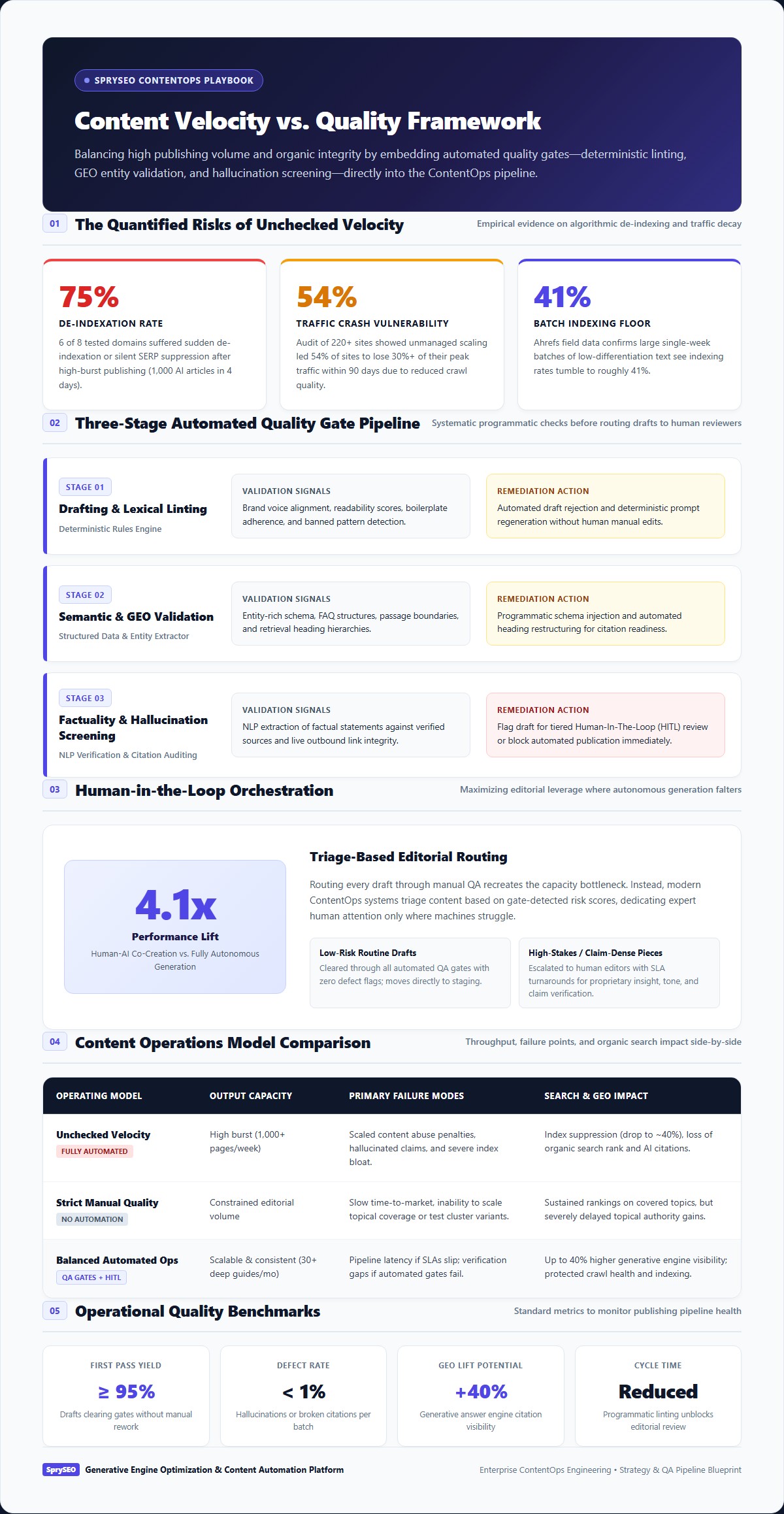
| Production Stage | Automated Quality Gate | Validation Signal | Remediation Action If Failed |
|---|---|---|---|
| Stage 1: Drafting & Lexical Linting | Deterministic Style & Compliance Check | Brand voice alignment, readability scores, boilerplate adherence, banned pattern detection | Automated draft rejection and deterministic prompt regeneration |
| Stage 2: Semantic & GEO Validation | Entity Salience & Structured Data Verification | Entity-rich schema, FAQ structures, passage extractability, heading hierarchies | Programmatic schema injection and automated heading restructuring |
| Stage 3: Factuality & Hallucination Screening | NLP Claim Verification & Citation Auditing | NLP extraction of fact-checkable statements compared against trusted sources; link integrity | Flag draft for tiered human-in-the-loop review or block automated publication |
Stage 1: Deterministic Linting
Deterministic linters enforce style, terminology, and formatting consistency. Because these rules are unambiguous, they can reject drafts and trigger regeneration without human intervention, removing the most repetitive editorial work.
Stage 2: Programmatic SEO and GEO Validation
Stage two embeds Generative Engine Optimization standards directly into the drafting pipeline. Optimizing for entity salience, structured data, and authoritative citations can increase content visibility in generative answer engine responses by up to 40%. Verifying schema, headings, and passage extractability programmatically means every draft meets citation-ready structure by default.
Stage 3: Claim Verification and Hallucination Screening
Automated fact-checking systems first scan content to pinpoint statements that require verification, using NLP to distinguish opinions from fact-checkable claims, then extract and sort those claims for analysis. Drafts that cannot clear this gate are escalated rather than published\u2014the critical control against hallucinations at scale.

Human-in-the-Loop Orchestration: Maximizing Editorial Leverage
The most successful AI implementations are not fully autonomous; they are human-AI co-creation models. Data shows AI as a co-creator performs 4.1 times better than fully automated output, because AI performs best within the boundaries of its training data but falters on novel situations, high-stakes judgments, and nuance.
Risk-Tiered Editorial Routing
The goal is not to review everything manually\u2014that recreates the original bottleneck. Instead, route drafts by risk. Routine, low-risk pieces that pass all automated gates can move quickly, while high-stakes or claim-dense topics are flagged for full human review. This triage concentrates editorial expertise where it changes outcomes.
Shifting Editors from Drafting to Curation
Automation lets editors breathe. Let the machine hunt for broken citations and formatting tells; people should spend their hours on voice, strategy, and the judgment a script will never catch. The editorial mindset shifts from producing drafts to curating, fact-checking, and injecting genuine information gain.

Enforcing SLAs to Keep Pipelines Moving
Human review only works at velocity if it has guardrails. Clear service-level agreements on review turnaround prevent editorial queues from becoming the new bottleneck, keeping the automated pipeline flowing while preserving the human checkpoint.
Operational Friction: Volume Quotas vs. Search Engine Quality Thresholds
A persistent controversy is whether rapid publishing velocity by itself triggers algorithmic suppression, or whether search engines evaluate page quality independently of output frequency. The weight of evidence points toward quality as the trigger.
The Crawl Budget Debate
Concerns about crawl budget exhaustion are often overstated. According to Google representatives Gary Illyes and John Mueller, crawl budget primarily concerns massive websites\u2014those with over one million unique pages updated weekly or more than 10,000 pages changing daily\u2014meaning most sites do not need to worry about depletion. Mueller has been direct that crawl budget is overrated for most sites.
Managing Organic Discovery Volatility
That does not make high output risk-free. The Ahrefs dataset showing indexing rates dropping to 41% for large single-week batches illustrates that discovery and indexing become volatile when quality signals are weak. The resolution is not to publish less for its own sake, but to ensure every page clears the quality threshold before it ships. A thousand genuinely useful pages are fine; a thousand near-identical pages built only to catch search traffic are not.
Measuring the Velocity-to-Quality Balance
You cannot manage what you do not measure. Balancing velocity and quality requires tracking both operational throughput and downstream search performance.
| Operating Model | Weekly Output Potential | Primary Failure Modes | Search & GEO Impact | Operational Overhead |
|---|---|---|---|---|
| Unchecked Velocity (Fully Automated) | High burst (hundreds to 1,000+ pages/week) | Scaled content abuse penalties, hallucinated claims, index bloat, de-indexing | Index suppression (indexing rates dropping to 40\u201341%), loss of organic rankings and AI citations | Low upfront effort; severe remediation and domain recovery costs |
| Strict Manual Quality (No Automation) | Constrained (low throughput from manual bottleneck) | Slow time-to-market, inability to scale topical coverage or test variants | Sustained rankings on covered topics, but delayed topical authority gains | High manual overhead and bottlenecked review cycles |
| Balanced Automated Ops (QA Gates + HITL) | Scalable and consistent (e.g., 30+ highly optimized articles/month) | Pipeline latency if SLAs slip; verification gaps if gates fail | Up to 40% higher generative-engine visibility; protected indexation and topical salience | Optimized overhead; automated filtering frees editors for voice and verification |
Pipeline Efficiency Metrics
Borrowing from mature operational practice, track Cycle Time (Total Time / Units Produced), Defect Rate (Defective / Total Units \u00d7 100, with a benchmark under 1%), and First Pass Yield (Good Units / Total Started \u00d7 100, with a benchmark of 95% or higher). First-pass gate yield reveals how often drafts clear automated checks without rework\u2014a direct proxy for pipeline health.
Impact Benchmarks
Operational efficiency only matters if it produces results downstream. Pair the pipeline metrics above with search and generative performance indicators: indexation rates for published batches, organic ranking movement, and citations in generative engine responses. Together, these two measurement layers reveal whether velocity gains are compounding into visibility or quietly eroding it.

Author
This article was produced by the SprySEO editorial team. SprySEO is an SEO and GEO content automation platform that connects website analysis, topic planning, AI article generation, SEO and GEO checks, and scheduled publishing to help brands gain visibility in search engines and AI answers. The team writes for content operations managers, SEO specialists, and digital marketing teams seeking to scale organic rankings and AI answer engine citations without sacrificing quality.
Disclaimer
This article is for informational purposes only and does not constitute professional SEO, legal, or business advice. Search engine policies, generative engine behavior, and the cited studies reflect conditions at the time of writing and may change. Results vary by site, industry, and implementation; readers should validate strategies against current platform guidelines and their own data before acting.
Frequently asked questions